“The illiterate of the 21st century will not be those who cannot read and write, but those who cannot learn, unlearn, and relearn.” -Alvin Toffler

Monday, December 3, 2012

Project Wildfire: A Community Approach to Surviving Wildfires

Centers for Disease Control and Prevention CDC 24/7: Saving Lives. Protecting People. Saving Money through Prevention.™. 


Wildfires burning brush and treesBy Kate Lighthall
Project Wildfire in Deschutes County, Oregon has been recognized by CDC’s Office of Public Health Preparedness and Response’s (OPHPR) Learning Office and the CDC FoundationExternal Web Site Icon as a community effort that reflects and embodies FEMA’s Whole Community approach to emergency management.

Although central Oregon experiences other natural and man-made disasters, wildfires are by far the biggest threat here, especially during the summer months.  In an average year, we experience 450 fires that burn 50,000 acres and homes, threaten lives and impact the economy.  Following two devastating wildfires that burned in Bend, Oregon in 1990 and again in 1996, the Fire Chief of Deschutes County, Oregon, Gary Marshall, received a phone call from Safeco Insurance offering to contribute to the purchase of new firefighting equipment. Marshall politely declined Safeco’s offer because he had a more effective, long-term solution in mind that involved educating the public about the risks of wildfires.

Firefighter extinguishing a fire

Marshall asked Safeco Insurance if they would invest in an education program designed to teach people to help themselves prepare for wildfires. “A new piece of equipment might save one more home,” Marshall said. “But to really save homes, individuals have to take responsibility for their property before a fire.” His ultimate aim: To change the values and behaviors of citizens for generations to come. 

Safeco agreed and FireFreeExternal Web Site Icon was born.  FireFree is a year-round educational program that was launched to promote 10 simple steps that homeowners can take to protect their homes from wildfires and reduce their risk of loss.  The number one FireFree tip, and the main focus of the behavior change campaign, is to create “defensible space,” a minimum 30-foot buffer zone around a house that can be created in one weekend, and easily maintained.  To encourage citizens to prepare for wildfires, FireFree partners with Deschutes County Department of Solid Waste and Deschutes Recycling to provide free collection and recycling of yard debris and waste during the spring.  Later in the fall, residents can recycle their yard debris at Deschutes Recycling for half price.  The program ran with the tagline, “It’s quick. It’s simple. It’s everybody’s responsibility.”  Sixteen years later, FireFree continues to effectively change attitudes and behaviors about wildfires.

This initial program became part of a larger endeavor.  County elected officials took notice of these efforts and passed a county ordinance that created Project WildfireExternal Web Site Icon to help manage and support FireFree, as well as provide long-term wildfire mitigation strategies.  At the core of Project Wildfire’s organization is a community driven approach, with a diverse membership that provides a wealth of local knowledge and broad educational outreach.

The FireFree story is just one of Project Wildfire’s accomplishments.  Since the initial push in the late 1990s to educate communities in Deschutes County, Project Wildfire has become the local coordinating group that facilitates, educates, and disseminates efforts about the importance of wildfire safety across the community.  Project Wildfire is the facilitator and caretaker of seven Community Wildfire Protection Plans (CWPPs), coordinates a countywide Sweat Equity (FireFree based) Program, and Evacuation Preparedness program and is recognized as a wildfire mitigation resource across the state and the nation.
While Project Wildfire has accomplished much over the last decade, our achievement is due in no small part to our successful working relationships with our partners.  We continue to implement programs that encourage neighbor-to-neighbor education and understanding while leveraging opportunities for public/private partnerships. 

wildfire blaze

The Whole Community Approach

The “Whole CommunityExternal Web Site Icon” is FEMA’s philosophical approach on how to conduct emergency management in a way that integrates the needs, capabilities, and resources across the community. It attempts to engage the full capacity of the private and nonprofit sectors, including businesses, faith-based organizations, and the general public, in conjunction with the participation of federal, state, local, territorial, and tribal government partners. 

Project Wildfire has been identified as one of seven programs to continue their Whole Community work during the pilot program period October 2012 – March 2013. During this time, we will provide a learning opportunity for CDC and CDC Foundation staff to gather information on what works well in starting and maintaining community programs, identifying strategies to create and build partnerships, and techniques to empower local action. The project findings will outline recommendations for fostering a Whole Community approach to emergency management, sustainability, and program replication. 

We’re proud to be one of the seven community organizations selected as a promising example of FEMA’s Whole Community model.  We look forward to highlighting the progress we’ve made toward preparedness in Deschutes County, Oregon and contributing to a national effort to make sure America is prepared for emergencies.

To learn more about Project Wildfire, please contact Kate Lighthall at klighthall@bendcable.com or visit us on the web at www.ProjectWildfire.orgExternal Web Site Icon or www.FireFree.orgExternal Web Site Icon.

Follow #PromisingExample on Twitter to learn about the other six communities that embody a whole community approach to emergency management.

Friday, November 30, 2012

The Great Debate: Practical vs Ph.D. to get ahead in DC....

FP Logo

http://drezner.foreignpolicy.com/posts/2012/11/29/so_you_want_to_get_a_phd_to_work_in_dc
So you want to get a Ph.D. to get ahead in DC....

Posted By Daniel W. Drezner Share

So, my post about good and bad reasons to get a Ph.D. in political science has made a few waves.  I'd like to clarify, endorse and respond to some of the feedback I've received. 

Just to recap, here was the primary point of my post:
Even standard political science departments are littered with students who have sterling resumes, glittering letters of recommendation from well-connected fixtures of the foreign policy community, and that disturbing tendency to look past the task at hand to plot out steps three, four and five of their Ascent to Greatness.
Here's the thing about these students: 95 percent of them will not earn a Ph.D. -- and most of the rest who do get it will only have done so by finding the most pliant dissertation committee alive. Ambition and intelligence can get someone through college and a professional degree. It can even get someone through Ph.D.-level coursework. What it can't do is produce an above-the-bar dissertation.
In my day, I've known too many students who were talented in many ways, and yet got stymied at the dissertation phase. For people who have succeeded at pretty much everything in life to that point, a Ph.D. seems like just another barrier to transcend. It's not. Unless you are able to simultaneously love and critically dissect your subject matter, unless you thrive in an environment where people are looking forward to picking apart your most cherished ideas, you won't finish.
Now, some of the comments and tweets about this post suggested that I was pooh-poohing the idea of getting a Ph.D. if you don't want to become a professor.  To be clear:  that is not what I was trying to say.  Indeed, if anything, given the state of the academic job market I heartily endorse "non-traditional" career paths for Ph.D.s.  Furthermore, as Joshua Foust notes in his response, "If you want to succeed in Washington, a PhD is the quickest path to it. Anything less is just an uphill battle." 

There is no shame in going from a doctoral program to a job in DC, and I was certainly not implying that there should be. 

Foust offers a strong counter-explanation for why aspiring policy wonks should go for a Ph.D.:
[A] PhD offers a better way for many [than getting a professional M.A.]. PhDs are usually funded, which means they cost nothing to the student (stipends may not be much, but that’s a separate matter — the financial loads are drastically different). They also take a lot longer, say 5 years minimum but more likely 7 if you’re young and right out of undergrad.
Even so, that PhD is more or less free. Entering the DC workforce with a PhD, instead of a Masters, is an instant leg-up. For organizations like think tanks, it instantly signals research skills; for NGOs it signifies a strong work ethic. And for many government jobs, contractor jobs, or jobs at IGOs like the World Bank or IMF, it is a basic minimum requirement for most non-admin jobs. In almost any field, having a PhD is a shortcut to the initial round of CV scrutiny — an easy and quick way to sort candidates.

Now, let's assume Foust is correct about the money (doctoral students about to comment that a doctorate is not "more or less free" -- I know!!  I'm not asserting this, Foust is!!  Go bug him!!!).  It seems like the Ph.D. is the smart play then, right? 

Wrong.  Foust is assuming that the choice is a binary one -- between climbing the policy ladder without a a doctorate or with a doctorate.   The point of my initial post is that there's a third possibility, and it's the one that will fell people getting a Ph.D. for professional reasons only -- that one will start a Ph.D. program but never finish

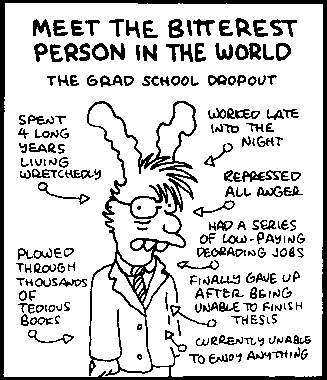
First of all, that is, by far, the worst outcome.  Matt Groening can express this far better than I: 
The most accurate cartoon ever
In all seriousness, life is not quite this bad for those who fail to finish.  It's not great, however.  For those who recognize early on that the Ph.D. is not for them, it's OK.  Exiting a doctoral program after, say, three years with a terminal masters is about as graceful an exit as one can execute. 

The more years one stays in, however, the greater the pain of exiting.  There's a lot of psychological scarring, and the networks built up in a doctoral program are likely inferior to those that would be built up via a lower-level policy job.  And I'd wager that it's precisely the ambitious, career-minded DC types who are less likely to cut and run -- because their entire life experience to date suggests that quitting is the wrong course of action. 

Furthermore, not finishing a Ph.D. is not exactly uncommon.  Click on this slide show about Ph.D. attrition rates from the Council of Graduate Schools, and note the following three facts:

1)  Only 46% of all entrants finish their Ph.D. after seven years in a program.   
2)  For social science Ph.D.s, that figure is even lower -- 41%
3)  If you extend it out to ten years, the lowest completion rate among the social sciences is political science -- only 44% complete a doctorate after a decade.  In other words, entering a Ph.D. program and then not finishing is the modal outcome

Foust is likely correct that getting a Ph.D. gives one a leg up in the DC policy wonk rat race.  But I know I'm correct when I say that starting but not finishing a Ph.D. is the worst possible career trajectory.  It is this outcome that I'm harping on when I'm warning ambitious go-getter policy wonks to think long and hard about why they want to get a doctorate.  It can't just be to win "The Game." 

Now, to be fair, Tara Maller makes a valid point when she notes that "personal challenges" can fell a Ph.D. candidate.  However, I would argue that the biggest impediment to finishing is not having a clear idea of what's involved in getting a doctorate in the first place.   In an email from Afghanistan, Lieutenant Colonel Jason Dempsey -- a Columbia Ph.D. and published scholar -- made this point: 
Part of the dynamic I think is 'degree-inflation' where everyone has a master's, so it seems logical that to distinguish yourself from the pack that a PhD is the next logical step.  While finishing my dissertation I had quite a few officers who had just finished MA or MPA programs asking how they could proceed to a PhD, with no idea that they were two entirely separate animals.

I've also had to break it to people that publishing an academic book is not the road the glory it might seem from afar, and that the most you can expect out of it beyond the intrinsic reward of contributing to an ongoing discussion is a box of very heavy 'business cards'....
Knowing what you are getting into and the need to fully embrace the topic are key to success.  Sometimes that will align with a non-academic career-- probably more often not....  The difference between an MA and a PhD isn't incremental but fundamental, and that is a hard gap to bridge when coming from an institution that is decidedly pragmatic and application-oriented as a matter of survival.
Dempsey's point is the one I was trying to ham-handedly make in my last post.  It is natural for people in DC to believe that the Ph.D. is the next logical step after a professional or masters degree.  It.  Is.  Not. 

When asked about whether getting a Ph.D. is a good idea, I usually tell men that writing a dissertation is the closest experience they will have to being pregnant -- except that instead of nine months they'll be carrying that sucker for 2-5 years.  I then tell women that, of course, writing a dissertation is not remotely close to being pregnant -- but take the most volatile relationship from your past and then multiply that volatility by a factor of fifty.  That's what it's like.  And I haven't even gotten to the incredible socialization pressures within graduate school to feel like you should pursue an academic career instean of a non-academic one. 

Despite these barriers, is it possible to simply "grind out" the Ph.D. without loving the subject matter and the process?  Yeah, in theory.  I've met one or two extraordinary people in my day who were able to pull that off.  But -- and I cannot stress this enough -- I've met far more people who thought they could grind it out and then met their ruin on the shoals of some doctoral program.  These are the people who stay in a doctoral program long after everyone else knows that the jig is up.  That is the fate I am warning policy wonks  away from. 

There is no shame in thinking that a Ph.D. gives one a leg up in the Beltway job market.  But that cannot and should not be the primary reason to get a doctorate.  What separates a Ph.D. from other degrees is the scholarly act of writing a dissertation.  If there is no genuine fascination with the subject matter, if there is no love of the topic, then there is a 99.5% probability of failure.  That has to be the primary driver.  If it's fame and fortune, then the professional degree route -- a J.D., an M.B.A. or a M.A.L.D. -- is the better route for you. 

Steve Saideman sums up why I'm making this argument so vehemently: 
An MA is a professional degree for the policy-maker but most PhDs are not that.  They require patience, analytical rigor, the ability to think theoretically, to be open to criticism, and so on.  So, [Dan] has seen those who are in it just for the stamp flounder and fail. 
That's correct.  Maybe I'm exaggerating the costs of failure here -- but I don't think so. 

So, to conclude.  There is no shame in getting a Ph.D. with the intention of pursuing a non-academic career.  Foust is correct that there are certain material rewards that come with earning a Ph.D.  But unlike other degrees, those rewards cannot be the principal reason you choose to pursue a doctorate.  That is the recipe for misery and heartbreak. 

Popular Posts

ARCHIVE List 2011 - Present

Search This Blog

Environmental Justice

Recovery\Homeless Shelters. U.S.