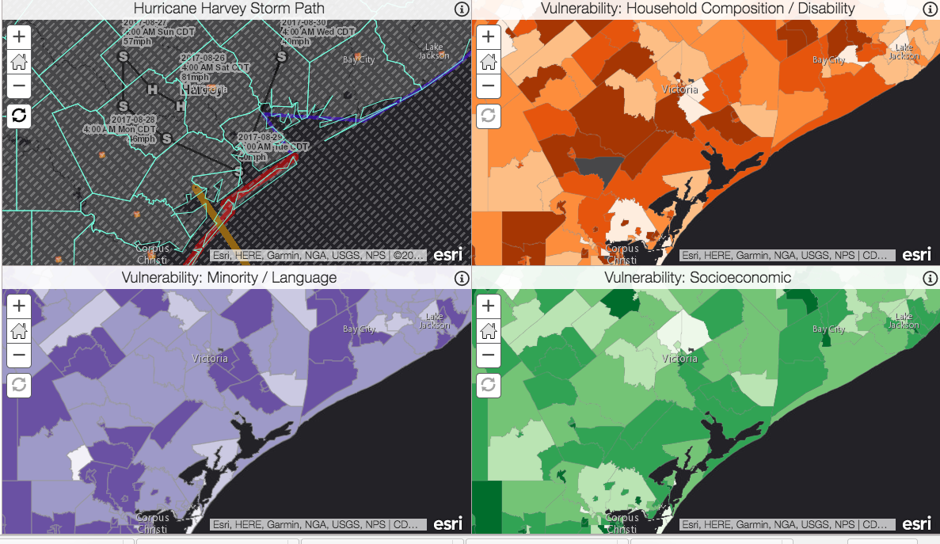
Aid organization Direct Relief has created maps using ESRI that show the poor, immigrant, elderly and disabled communities in harm’s way.
Updated on August 27 at 3:30 p.m.
At least five deaths and dozens of injuries have been attributed to Hurricane Harvey, as it pummeled parts of the Houston region with 24 inches of rain and swirling winds. The storm has been downgraded to a tropical storm, from a Category 4 at its height, but catastrophic flooding is expected to intensify as rains continue, according to the National Weather Service.
Like in the case of previous disasters like Katrina and Sandy, the heaviest cost of Harvey’s destruction is likely going to be borne by the most vulnerable communities in its path. Here’s what disaster historian Jacob Remes tweeted out about Harvey:
Humanitarian aid organization Direct Relief has created interactive ESRI maps that show exactly where these communities are. The mapmakers have used the Centers for Disease Control and Prevention (CDC) social vulnerability index to show the geographic distribution of households with elderly or disabled members (in orange), immigrant and limited English-speaking populations (in purple), and pockets of poverty (in green). The darker the color, the higher the concentration of these factors in each region:
While many South Texans evacuated north per the recommendation of Governor Greg Abbott, poorer or disabled residents may not have had the resources or the capability to follow that advice. Many undocumented immigrants, as well, may have chosen to stay behind because Border Patrol refused to suspend its checkpoints during the storm. (The governor did affirm, however, that shelters will be exempt from immigration enforcement.) Some inmates were evacuated, while others are weathering the storm in place.
Within cities, poor communities of color often live in segregated neighborhoods that are most vulnerable to flooding, or near petrochemical plants and Superfund sites that can overflow during the storm. This is especially true for Houston—a sprawling metropolis, where new development has long been spreading thinly across prairie lands that help absorb excess rainwater. And it’s long been understood that the city is unprepared to handle the effects of a storm as unprecedented as this one.
Entergy New Orleans will kick off the
community-wide fundraising effort with a major gift announcement.
In conjunction with the announcement, the
"Neighbors Helping Neighbors" recovery initiative will open with a
volunteer build for the Dorsey family, whose home was destroyed in the Feb. 7
storm.
Following the media announcement, Entergy
volunteers, SBP staff and HandsOn
New Orleans will raise the walls on a new home for the Dorsey family. The
volunteer build will continue throughout the day for live-shot opportunities.
###
About United Way of Southeast Louisiana
For
more than 90 years, United
Way of Southeast Louisiana (UWSELA) has been a leader and trusted partner
in improving lives and making a lasting difference. We fight to eradicate
poverty by preparing people for quality jobs, growing incomes, and affording
better health and education opportunities throughout Jefferson, Orleans,
Plaquemines, St. Bernard, St. Tammany, Tangipahoa, and Washington parishes.
We have a bold vision of equitable communities where all individuals are
healthy, educated, and financially stable - and we have a plan. United Way of
Southeast Louisiana's Blueprint
for Prosperity guides all strategic investments in programs, initiatives,
collaborations, volunteerism, and advocacy aimed at tackling poverty. For
more information, please visit UnitedWaySELA.org.
Find us on social: @UnitedWaySELA.
About SBP
SBP's mission is to shrink time between disaster and recovery. Since its
founding in 2006 in St. Bernard Parish, Louisiana following the devastation
wrought by Hurricane Katrina, SBP has rebuilt homes for more than 1,300
families with the help of 180,000 volunteers in New Orleans; Joplin, MO;
Staten Island, NY; Rockaway, NY; Monmouth and Ocean Counties, NJ; San Marcos,
TX; Columbia, SC; White Sulphur Springs, WV and Baton Rouge, LA.
SBP's model is enhanced by AmeriCorps, which provides 180 members annually to
manage worksites and clients, and train the organization's volunteers
nationally. Through its Disaster Resilience and Recovery Lab (DRRL), SBP
works to share lessons learned, prevent common barriers to recovery and help
communities utilize SBP's standardized, repeatable and proven-effective
model.
SBP shrinks time between disaster and recovery via five interventions:
Rebuild homes quickly after disasters by
mobilizing private sector innovations and assigning a single point of
contact to make the home rebuilding process faster and more predictable.
Share rebuilding innovations with
other rebuilding organizations to allow for efficient, predictable
recovery on a national scale.
Prepare home and business owners prior
to and following disaster with specific steps to mitigate risk and
improve resilience.
Advise policy makers immediately after
a disaster so they can deploy federal dollars sooner, and in a way that
empowers an efficient recovery.
Advocate for the reform of disaster
recovery strategies in the U.S. to improve the predictability and speed
of recovery.
To learn more, visit www.SBPUSA.org
and like/follow on Facebook & Twitter @SBPUSA
Kirby Jane Nagle
Public Information Officer
United Way of Southeast Louisiana
ph:
501.697.0415
Small
Business Administration to Offer Disaster Assistance to Residents
Affected by August 5 Flooding
Outreach Center will
open tomorrow, August 23
NEW
ORLEANS - Today, Mayor Mitch Landrieu announced that the U.S. Small
Business Administration (SBA) will offer low-interest federal disaster loans
to Louisiana businesses and residents affected by flooding that occurred
August 4-6, including August 5 flooding in New Orleans.
Loans are open to businesses of all sizes, most private nonprofit
organizations, homeowners, and renters whose property was damaged or
destroyed by the flooding. The disaster declaration makes SBA assistance
available in Jefferson, Orleans, Plaquemines, St. Bernard and St. Tammany
parishes.
Beginning Wednesday, Aug. 23 through Thursday, Sept. 14, SBA representatives
will be on hand at the Disaster Loan Outreach Center to answer questions
about SBA's disaster loan program, explain the application process and help
each individual complete their application. The center (Mid-City Library,
4140 Canal St. on the second floor in the Long Room) will be open from 10
a.m. until 7 p.m. Monday through Thursday and from 10 a.m. until 5 p.m. on
Fridays. The Center will be closed in observance of Labor Day on Monday,
Sept. 4.
For small businesses, small agricultural cooperatives, small businesses
engaged in aquaculture and most private nonprofit organizations of any size,
SBA offers Economic Injury Disaster Loans to help meet working capital needs
caused by the disaster. Economic injury assistance is available regardless of
whether the business suffered any property damage.
Disaster loans up to $200,000 are available to homeowners to repair or
replace damaged or destroyed real estate. Homeowners and renters are eligible
for up to $40,000 to repair or replace damaged or destroyed personal
property.
Applicants can apply online, receive additional disaster assistance
information and download applications at https://disasterloan.sba.gov/ela. Applicants
can also call SBA's Customer Service Center at (800) 659-2955 or email disastercustomerservice@sba.gov for more information on SBA
disaster assistance. Individuals who are deaf or hard-of-hearing may call
(800) 877-8339. The filing deadline to return applications for property
damage is Oct. 23, 2017. The deadline to return economic injury applications
is May 22, 2018.
SBA
declared a disaster in response to a request received from Gov. John Bel
Edwards on Aug. 17, 2017.
•Texas Governor has
requested a major declaration for 6 counties along the gulf coast
•FEMA Region 6 RRCC
remains at a Level I
•Texas SEOC remains at
a Level I
SITUATION:
·Texas
Governor has requested for a major declaration request for counties along the
coast. The following counties are included in the request for Individual
Assistance and Public Assistance (Categories A and B); Bee, Goliad, Kleberg,
Nueces, Refugio and San Patricio. Direct Federal Assistance and Hazard
Mitigation statewide is also being requested.
·Hurricane
Harvey has increased to a CAT 3 hurricane with wind speeds of 125 mph and a
deadly storm surge of 6 - 12 feet above ground levels
·Continues
to move slowly northwest toward the middle Texas Coast. Harvey is
forecast to make landfall late Friday/early Saturday as a major hurricane (CAT
3)
·Heavy
rain and areas of flooding are likely through the weekend over south east and
east Texas into west Louisiana
ACTIONS/FOLLOW UP:
•R6 RRCC SAS will
continue to monitor and report as necessary