|
|
Tuesday, September 7, 2021
"Winter Is Coming". COVID Testing. Protect your loved ones. Vaccinations: Your right to, or not to.
Debris Removal. New Orleans. September 7. 2021
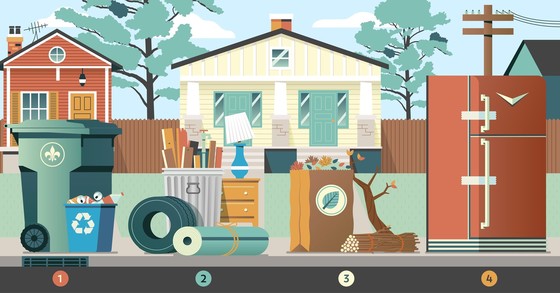
Prepare for Debris Pickup Beginning on 9/7

The City of New
Orleans has activated its emergency debris removal contracts to assist with
storm-related cleanup. The
first debris removal pass is scheduled to take place on Tuesday, Sept. 7. Do not block
roadways or place debris near trees, poles, or fire hydrants. Please follow
these guidelines:
- Debris must be placed between
the sidewalk and the curb for removal by the City or its
contractors.
- Avoid placement of storm debris
waste under or on power lines, near trees, utility poles/boxes, fire
hydrants, behind parked cars or on neutral grounds.
- Only debris resulting from
Hurricane Ida is eligible for removal by the City’s emergency debris
removal contractors.
- Any work done by contractors is
ineligible for debris removal services by the City or its contractors.
- Commercial properties and
properties serviced by private trash contracts are ineligible to receive
bulk waste collection or debris removal services by the City or its
contractors.
- Separate debris into the
following categories:
- HOUSEHOLD GARBAGE
Bagged garbage, discarded food, paper,
packaging. (Use City issued trash cart when possible)
- CONSTRUCTION
DEBRIS
Building materials, drywall, lumber, carpet,
furniture, etc.
- UNBAGGED
VEGETATIVE DEBRIS
Logs, leaves, tree branches, plants.
- APPLIANCES
Doors must be sealed/secured.
Curbside Solid
Waste Collection
Limited curbside
solid waste collection resumed on Thursday, Sept. 2. The City's
solid waste contractors will only be dumping the City- issued 95-gallon trash
cart during these initial passes. Residents should continue to bag their
rotting waste, place in the City-issued trash cart and leave their carts on the
curb until they are emptied; it will take some time for sanitation contractors
to complete the full, citywide collection cycle.
Monday, September 6, 2021
Some trucking businesses warn that the country’s shortage of drivers could lead to fuel shortages and higher prices at the pump
Training can start before release.
Give hope before release.
|
Some trucking businesses warn that the country’s shortage of drivers could lead to fuel shortages and higher prices at the pump —Damian Dovarganes/AP Photo https://ewns.news/us-truck-fleets-seek-out-foreign-drivers-to-solve-labour-shortage/?amp=1 A dearth of workers willing to drive trucks has become so severe in the US that some fleet managers are petitioning to let more foreign operators into the country. Truck driving has always been a job with high turnover and a scarcity of labour. But the shortage has deepened since the pandemic, as training schools closed, some drivers quit and a stricter drug and alcohol testing system led to about 60,000 dismissals, said Bob Costello, chief economist at American Trucking Associations. The shortfall is “the worst ever”, he said. Certain smaller trucking companies are now imploring the US government to loosen or hasten visa approvals to alleviate strained supply networks. At Petroleum Marketing Group, a fuel distributor to more than 1,300 petrol stations on the US east coast, vice-president of operations André LeBlanc said he had gone “on the warpath”to warn governors, senators and the US transportation and labour departments that the lack of drivers could see fuel shortages and increased prices at the pump. He said officials could ease the situation by speeding up approval of EB-3 permanent work visas, which allow employers to bring in those “performing work for which qualified workers are not available in the US”. The scheme has an annual quota of 40,000. “I don’t think this is going to get better, but we have a solution and I’m trying to get somebody to listen to me,”LeBlanc said. Andrew Owens, chair of the board of Oregon Trucking Associations, said the idea of turning to foreign drivers was “picking up steam”. He is organising about a dozen trucking companies to meet federal lawmakers to “plead our case on just expediting EB-3s”. Part of their pitch will be to try to get truck drivers on the US Department of Labor’s “Schedule A”list. This designation, which identifies occupations deemed to be facing a shortage of qualified individuals, could shave 10-12 months off an EB-3 process that typically takes around 18 months, said Jose Gomez-Urquiza, chief executive of Visa Solutions, which places foreign workers in the US transport industry. Another option would be to hire seasonal truck drivers on H-2B visas, which allow foreign workers to take temporary jobs that are difficult to fill domestically, Gomez-Urquiza said. Washington could ease pressure on supply chains by exempting truck drivers from the visas’60,000-person yearly quota, said Anda Malescu, managing partner at the Miami business and immigration law firm Malescu Law. It has already raised the cap on H-2B visas by 22,000 for this fiscal year. LeBlanc surmised that officials found the concept of bringing in workers unpalatable. One asked him: “You really want me to ask to try and bring in people from outside the US when we have so many people that are unemployed?”Malescu said trucking companies were most interested in drivers from Mexico and Canada, as their driving licences were recognised in the US. The US Department of Transportation said
that it was “actively engaged in increasing the availability of qualified
long-haul truck drivers”. Virginia-based Petroleum Marketing Group has only
26 of the 74 drivers it needs, LeBlanc said. “We’re
out there recruiting and we’re not getting any bites, not even a nibble, ”he said.
Additional reporting by Andrew Edgecliffe-Johnson in New York National Latino Farmers
& Ranchers Trade Association |
Sunday, September 5, 2021
COVID-19 Vaccine. What are the true costs? Costs for communities at risk (CAR)? South-to-South Nations? Communities of Color?
THE BOTTOM LINE.
- Simply what are the per dose costs of each of the manufacturors (Pfizer, Moderna, Johnson & Johnson, others to the U.S?
- Costs to nations in the Caribbean, Africa, Central & South America?
- Environmental Social Governance (ESG) of each of the manufacturers globally?
Chart below is just a summary of information received. Public requires just a simplistic view of current cost per dose.
COVID-19 Vaccine. U.S., Great Britain, EU, Other nations
|
|
U.S./dose |
Great Britain |
EU\dosage |
Other/dosage |
|
Pfizer |
|
£22 |
€19.50 |
At
Cost |
|
Moderna |
$25.50 |
$22 to $37 outside
the US |
|
|
|
Johnson
& Johnson |
|
|
$20.90 |
|
|
|
|
$2.15 |
over $5 |
|
Note:
·
Moderna.
a.
U.S. funded
the development of the vaccine
b.
Sales under the Covax vaccine initiative to
low-income countries were “considerably lower than the price to the US
government
·
AstraZeneca. Pledged to provide their doses on a not-for-profit basis until the pandemic ends
·
Johnson & Johnson. Pledged to provide their doses on a not-for-profit basis until the pandemic ends
COVID -19 Vaccine Costs. Phizer and Moderna Raise prices. August 1, 2021
https://www.ft.com/content/d415a01e-d065-44a9-bad4-f9235aa04c1a
Pfizer
and Moderna raise EU Covid vaccine prices
Calls for booster shots and spread of more infectious variants
underpin demand for products
Donato Paolo Mancini in Athens, Hannah
Kuchler in London and Mehreen
Khan in Brussels
AUGUST 1 2021
Pfizer raised the price of its Covid-19 vaccine by more than a quarter and
Moderna by more than a tenth in the latest EU supply contracts as Europe
battled supply disruptions and concerns about side effects from rival products.
The groups are set to generate tens of billions of dollars in revenue this year as they sign new deals with countries anxious to secure supplies for potential booster shots in the face of the spread of the highly infectious Delta coronavirus variant. The terms of the deals, struck this year for a total of up to 2.1bn shots until 2023, were renegotiated after phase 3 trial data showed their messenger ribonucleic acid vaccines had higher efficacy rates than cheaper shots developed by Oxford/AstraZeneca and Johnson & Johnson.
The new price for a Pfizer shot was €19.50 against €15.50 previously, according to portions of the contracts seen by the Financial Times.
The price of a Moderna jab was $25.50 a dose, the contracts show, up from what people familiar with the matter said was about €19 ($22.60) in the first procurement deal but lower than a previously agreed $28.50 because the order had grown, according to one official close to the negotiations.
The official said the companies had capitalised on their market power and deployed the “usual pharma rhetoric . . . Vaccines work so they increased the ‘value’.”
Pfizer last week raised its guidance for annual vaccine revenue by nearly a third to $33.5bn, after sales of the shot helped almost double sales in the second quarter. Chief executive Albert Bourla said prices for higher-income countries were “comparable”, with middle-income countries charged about half and lower-income countries paying cost. Pfizer, which shares profits with its German partner BioNTech, expects to raise prices after the pandemic is over. The revenue gap between messenger RNA vaccines, whose genetic instructions prompt cells to make viral proteins that prime the immune system, and more traditional rivals that contain either viral proteins or an inactivated virus, is set to widen further next year according to forecasts compiled for the FT by Airfinity.
The life sciences consultancy predicts sales of Pfizer’s shot will hit $56bn with Moderna’s reaching $30bn, as they dominate the high-income markets. Sales of the AstraZeneca jab, which is priced at cost and is the largest vaccine supplied to low-income countries, are forecast to rise to $15bn next year. The EU contracts were struck at a complex moment in the bloc’s vaccine rollout, as it faced supply problems from AstraZeneca and J&J as health authorities probed a suspected link between their shots and rare blood clots. Recommended Covid-19 vaccines Covid-19 vaccine tracker: the global race to vaccinate Brussels was also battling criticism from member states led by Austria that accused the European Commission of “unfair” vaccine distribution, arguing that the EU system had left some countries short on supply.
Officials said the commission and EU governments had agreed to pay a higher price to secure proved supplies from European manufacturing plants. The new Pfizer price is the same as that agreed earlier in the year on an advance of 10m doses, officials said. One official said staff working for Moderna were especially “preposterous and arrogant” in their dealings with the commission, highlighting a lack of previous experience in government affairs.
The revenue gap between messenger RNA vaccines and more traditional rivals is set to widen further next year © Jens Schlueter/Getty Moderna, whose Covid vaccine is its first commercially approved product, did not respond to a request for comment on the details of its EU pricing but pointed to previous disclosures that smaller-volume agreements would be executed at higher prices. It reiterated that it aimed to provide effective and affordable vaccines to “all populations”.
The FT reported last year that Moderna had initially asked buyers including the EU for a price of at least high double-digit dollars per course. The commission said Brussels has reserved the right for an additional 1.8bn doses of Pfizer’s vaccine “to be ready if booster shots are necessary and should we need additional vaccines in the context of variants”.
Pfizer declined to comment on pricing, citing confidentiality.
Popular Posts
-
Fiction and Reality. Is the planet ARAKUS (DUNE) becoming a reality. https://www.wired.com/story/why-tehran-is-running-out-of-wat...
-
https://www.differencebetween.com/difference-between-anthropocentrism-biocentrism-and-ecocentrism/ Difference Between Anthropocentrism Bi...
-
https://optiongray.com/ham-vs-satellite-phones/ Off-Grid Communications – HAM Radio vs. Satellite Phones Written by Option Gray i...