The
DHS Partnerships Center does not endorse any non-governmental organizations,
entities or services.
DHS Center for Faith-Based and
Neighborhood Partnerships
The
DHS Partnerships Center does not endorse any non-governmental organizations,
entities or services.
DHS Center for Faith-Based and
Neighborhood Partnerships
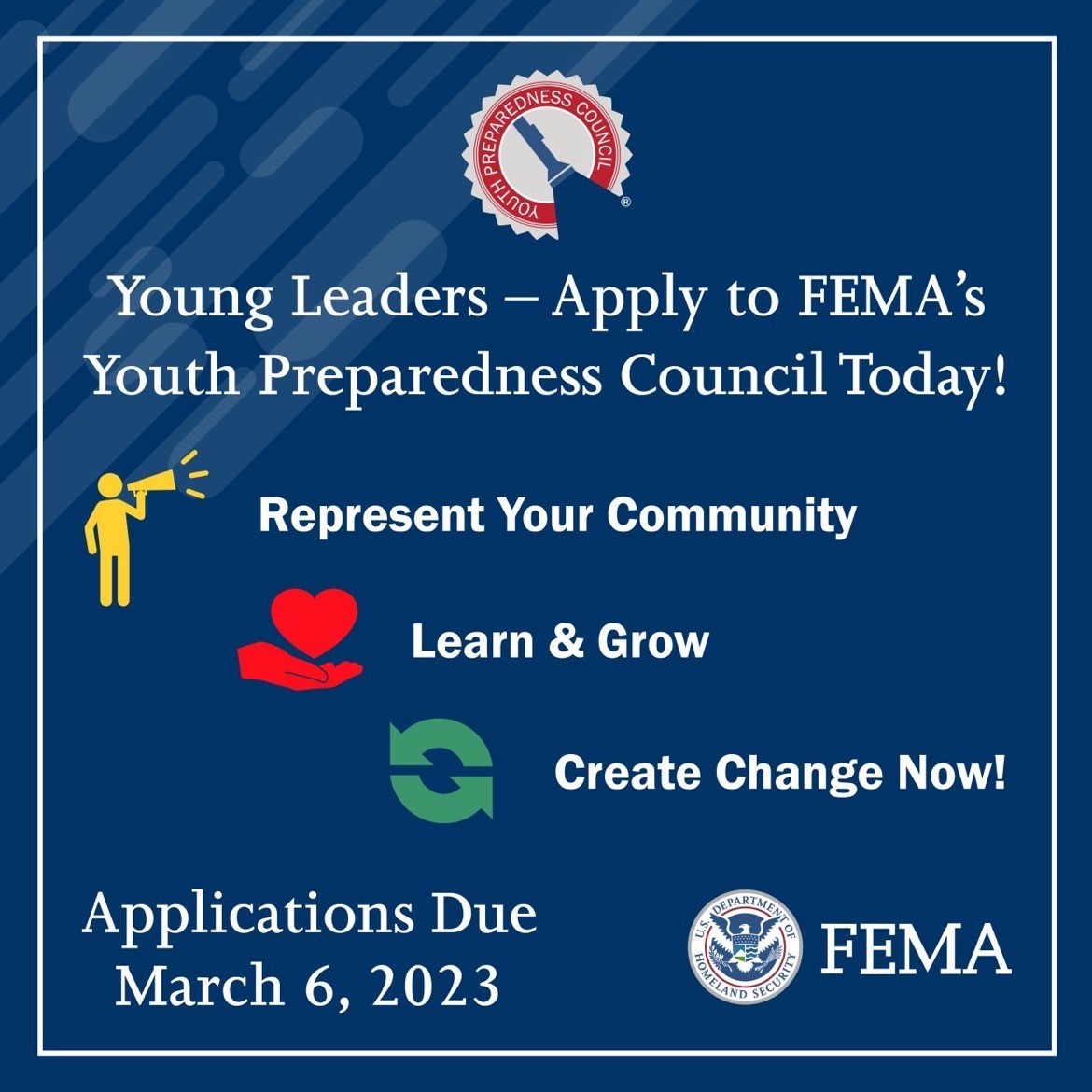
Do you know a young leader who is passionate
about making a positive impact on their community? The Federal Emergency Management
Agency (FEMA) is looking for students in grades eight through 11 interested in
supporting disaster preparedness to join the Youth Preparedness Council (YPC).
Why is it Important for
Youth to Apply?
FEMA created the Youth Preparedness Council in
2012 to bring together young leaders from across the country who are interested
in disaster preparedness and community service. The YPC demonstrates FEMA’s
commitment to involve America’s youth in preparedness-related activities. It
also provides young people an opportunity to present their perspectives,
feedback and opinions to FEMA staff.
During their terms, YPC members can make a
difference in their community, gain valuable leadership and emergency
management experience, and work with like-minded peers to help strengthen
preparedness and resilience across the country.
Learn more by joining the next informational
webinar taking place on Feb. 28, 2023.
The
online application is open, and closes March 6, 2023, 11:59 p.m. PT.
To
learn more about the YPC and application requirements, visit http://www.ready.gov/kids/youth-preparedness-council
and visit https://community.fema.gov/PreparednessCommunity/s/apply-to-ypc
to apply.

The
Cybersecurity and Infrastructure Security Agency (CISA) is committed to
supporting efforts to maintain safe and secure houses of worship and related
facilities while sustaining an open and welcoming environment. In partnership
with the Department of Homeland Security Center for
Faith-Based and Neighborhood Partnerships and
the Faith-Based Information Sharing and Analysis Organization,
CISA provides resources that assist in securing physical and cyber
infrastructure.
CISA
aims to provide a first stop for guidance and resources that will inform
FBO-HOW security-based decisions. Included below are numerous resources,
including a Guide and Self-Assessment Tool, which
provide building blocks for effective safety and security programs. The
resources include assessment, training, planning, exercises, and other
materials focused on a wide range of man-made threats (e.g., bombing, active
shooter, vehicle ramming, etc.) that could be used against the FBO-HOW
community.
|
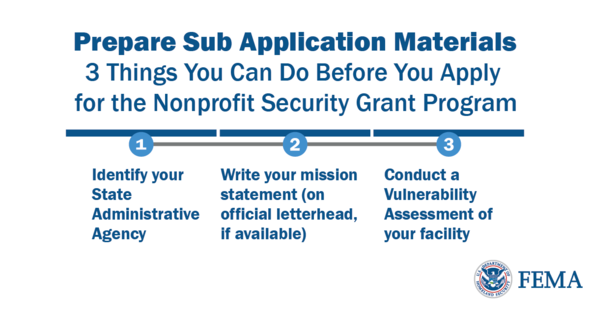
If you are considering applying for the
Nonprofit Security Grant Program, here are some resources. |
| |||||||||||||||||||||||||||||||||
|
WORDS INTO ACTION GUIDELINES: IMPLEMENTATION GUIDE FOR LOCAL DISASTER RISK REDUCTION AND RESILIENCE STRATEGIES Publication Year 2019 Number of pages 113 p. The Sendai Framework for Disaster Risk
Reduction 2015-2030 (Sendai Framework) charts the global course on disaster
risk reduction (DRR) matters over the next 15 years. It defines a set of
targets and indicators to monitor progress and achievement nationwide and
locally. Specifically, Target (E) calls to “substantially increase the
number of countries with national and local disaster risk reduction
strategies”. Drawing from consultations and discussions, and with the aim of
providing practical guidance to support the implementation of the new
framework, the United Nations Office for Disaster Risk Reduction (UNDRR)
introduces Words into Action (WIA) guidelines on selected topics. Local
disaster risk reduction and resilience strategies is one of them.
The aim of this guidebook is to advise local
governments (authorities, planners and managers at city or other subnational
levels) on developing and implementing a holistic and integrated local DRR
strategy that contributes to building resilience at the local scale and that
accommodates to a national strategy whenever one is in place. It outlines
what a local DRR and resilience strategy should look like and what is needed
to create and implement one. Local strategies, while aligned with their
national counterparts, are generally more specific. They reflect the local
context and hazard profile and tend to concentrate on the planning and
implementation phases, clearly assigning roles and responsibilities at the
subnational level.
The main body of the guidebook is
complemented with multiple resources. At the end of each section, the
guideline provides suggestions for further exploring specific aspects, useful
tools to put in practice some of the recommendations and additional
literature for those interested in the topic. Similarly, guiding questions
for local authorities, planners and managers are strategically placed across
the chapters to provide the reader with a space for reflection. The complete
list of questions is compiled in Annex II. Finally, vignettes of case studies
are included to illustrate the main recommendations and to highlight best
practices. Details of each case study are consolidated in Chapter 6.
|