“The illiterate of the 21st century will not be those who cannot read and write, but those who cannot learn, unlearn, and relearn.” -Alvin Toffler

Thursday, April 27, 2023

Farm Workers. Payment of Wages.


March 2, 2023
Best Practices: Timing and Payment of Wage

Federal law requires payment of wages as cash, negotiable instruments (i.e., checks) or under certain circumstances, by crediting the worker for tips earned or the reasonable cost (fair value) of board, lodging or other facilities provided by the employer. Wages under the Fair Labor Standards Act (FLSA) must be paid free and clear of any repayment obligations of any kind (e.g., kickbacks to the employer or its agent).  Wages subject to the FLSA must be paid on the employer’s regular payday for the 
covered pay period. 

With limited exception, California employers must pay wages at least twice a month on the employer’s regularly designated payday.  Employees of farm labor contractors must be paid weekly. Executive, professional, or administrative employees may also be paid bi-weekly or once per month on or before the 26th day of the month the employee performed work. Employers paying exempt employees once per month must include the unearned portion that falls between the date of payment and the last day of the month. 

California employers must pay all wages earned on and between the 1st–15th no later than the 26th day of the month. Wages earned between the 16th and the last day of the month, must be paid by the 10th day of the following month. Employer’s paying on weekly, bi-weekly or semi-monthly are required to pay wages within seven calendar days of the end of the payroll period. Overtime wages are due by the next regular payroll period. 

California allows the payment of wages to be made in cash or by check. Employers may, under certain conditions, deliver wages by direct deposit or payroll card. Voluntary consent must be given by employees to receive wages by direct deposit and the use of payroll cards is restricted such that employers must allow employees one transaction per pay period with no fees and provide notice of payroll card services and procedures. Written or electronic statements of earnings must be provided to all employees. 


Black Emergency Managers Association International
Washington, D.C.


bEMA International

Cooperation, Collaboration, Communication, Coordination, Community engagement, and  Partnering (C5&P)


A 501 (c) 3 organization


State in Emergency. Mob kills 13 suspected Haiti gangsters with gas-soaked tires


https://apnews.com/article/haiti-mob-gangsters-burn-to-death-88ed763d3f6714a03e627ec2add53572

Mob kills 13 suspected Haiti gangsters with gas-soaked tires

By EVENS SANONApril 24, 2023


PORT-AU-PRINCE, Haiti (AP) — A mob in the Haitian capital beat and burned 13 suspected gang members to death with gasoline-soaked tires Monday after pulling the men from police custody at a traffic stop, police and witnesses said.

The horrific vigilante violence underlined public anger over the increasingly lawless situation in Port-au-Prince where criminal gangs have taken control over an estimated 60% of the city since the July 2021 assassination of President Jovenel Moïse.

Six more burned bodies were laid in a nearby neighborhood later Monday, and some witnesses said that police killed them and residents set them on fire, but the AP could not verify the accounts independently.

Haiti National Police said in a brief statement that officers in the city’s Canape Vert section stopped and searched a minibus for contraband early Monday, and had confiscated weapons from suspects before they were “unfortunately lynched by members of the population.” The statement did not elaborate on how members of the crowd were able to take control of the suspects.

A witness who gave his name as Edner Samuel told The Associated Press that members of the crowd took the suspected gangsters away from police, beat them and stoned them before putting tires on them, pouring gasoline over them and burning them.

An AP reporter at the scene saw 13 bodies burning in a street.

The fires drew hundreds of onlookers in the hilly suburb of the city, many of them shielding their noses from the fumes. The Canape Vert neighborhood so far has managed to evade control by the criminal gangs.

Samuel said the suspects were believed to have been heading to another area to join a group of gang members who were battling police. Another witness, Jean Josue, said there had been a lot of shooting in the area since the early morning.

The situation in the capital was tense, and shots could be heard ringing out from several neighborhoods.

In the nearby area of Turgeau, a few minutes drive from Canape Vert, witnesses said that police had killed six gang suspects in a firefight, and that local residents dragged the bodies from where they fell to a central location and lit them on fire.

An AP reporter saw the six burned bodies. Police did not release any statements about the violence in Turgeau.

Prime Minster Ariel Henry tweeted that his government expresses its sympathy to the police officers injured in recent operations.

“I applaud the considerable and meritorious efforts of the National Police to restore order and peace in our cities and neighborhoods,” he tweeted. “There is still a lot to do.”

Witnesses in Canape Vert said the suspects there were believed to have been members of the Kraze Barye gang, which translates to “Breaking Barriers.” Authorities say the group is led by Vitel’Homme Innocent, who is accused of helping kidnap 17 U.S. missionaries in October 2021 and also is linked to the assassination of Moïse.


Black Emergency Managers Association International

Washington, D.C.


bEMA International

Cooperation, Collaboration, Communication, Coordination, Community engagement, and  Partnering (C5&P)


A 501 (c) 3 organization


Wednesday, April 26, 2023

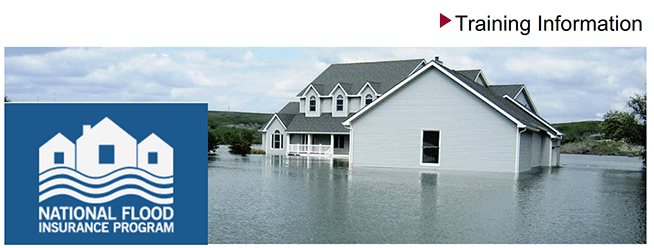
Flood Insurance. Key Fundamentals Webinar. May 2023


NFIP

Key Fundamentals of Flood Insurance Webinar 2.0

Presented by the National Flood Insurance Program

May Webinars - Register Now!
(Capacity is Limited)


Key Fundamentals of Flood Insurance for Agents 2.0
Parts One and Two

Please register for both parts of this course.

Part One: May 2 - 2:00 p.m. - 4:00 p.m. Central Time - REGISTER
Part Two: May 3- 2:00 p.m. - 4:00 p.m. Central Time - REGISTER

Part One: May 3 - 10:00 a.m. - noon Central Time - REGISTER
Part Two: May 4 - 10:00 a.m. - noon Central Time - REGISTER

Insurance agent continuing education course approval and credits vary by state. CLICK HERE for information about your state.

Can't attend these sessions? Watch for more opportunities soon.


TWO-PART KEY FUNDAMENTALS WEBINAR 2.0

Key Fundamentals of Flood Insurance for Agents 2.0 is a two-part course on FEMA's National Flood Insurance Program. It includes the topics listed in the Federal Register notice on training and education requirements related to Section 207 of the Flood Insurance Reform Act of 2004, otherwise known as FIRA 2004.

This course brings participants the latest information on the NFIP, including instruction on the NFIP’s pricing methodology – Risk Rating 2.0: Equity in Action. Both parts of this webinar were newly filed for continuing education credits in all 50 states and the District of Columbia in September 2021.

Key Fundamentals of Flood Insurance for Agents 2.0 also reviews the key elements that insurance agents need to know about the NFIP and how it works. The course discusses many of the federal flood program’s general rules as well as some more advanced topics. For more information, visit our Key Fundamentals of Flood Insurance 2.0 overview.

Attendees must complete both sessions in order to cover all topics required by the Flood Insurance Reform Act (FIRA) of 2004.


REGISTRATION INFORMATION

To register, please use the links above. These webinars are FREE to attend, but spaces are limited so please register early.

Can't attend these sessions? NFIP Training conducts webinars on flood insurance topics regularly. Watch for more upcoming opportunities. If you are not subscribed to NFIP agent training bulletins, please sign up here.


CONTINUING EDUCATION CREDITS

Continuing education course approval and credits vary by state for insurance agents. Click Here for information about your state. Some states (e.g. California, Illinois, Michigan, Nebraska, Oklahoma, Utah, Virginia and Wisconsin) require that both parts of the course be successfully completed on consecutive days to receive any credit hours.

Both parts of the course must be completed to meet the FIRA 2004 training requirement. Periodic learning checks will be conducted to measure attendee engagement. Learning checks must be completed by each registered attendee to earn continuing education credit. Only registered attendees are eligible to receive continuing education credits. No exam is required.

Currently, there are no continuing education credits available in Puerto Rico, Guam or the Virgin Islands.

State Mandatory Notifications
(Language is written as provided by the state)

Colorado - This two-part course is approved by the Colorado Division of Insurance for Continuing Insurance Education Credit.

Connecticut - Approved by the State of Connecticut Insurance Department for insurance producer continuing education credit.

Florida - Each part of this course has been approved by the Florida Department of Financial Services for insurance continuing education credit. FL Provider: H2O Partners, Inc. (#365883); Course: Key Fundamentals of Flood Insurance for Agents 2.0 (Part 1) - Webinar (#118697); Course: Key Fundamentals of Flood Insurance for Agents 2.0 (Part 2) - Webinar (#118698).

New Mexico - This course has been approved by the Insurance Continuing Education Committee as a New Mexico Insurance Continuing Education Course.

South Carolina - This course is approved by the South Carolina Department of Insurance for Continuing Insurance Education Credit.


Importance of MEAL in Emergencies. Monitoring, Evaluation, Accountability and Learning


Most people in the humanitarian sector use Monitoring, Evaluation, Accountability, and Learning (MEAL) every day but may not realize it.

An effective MEAL program sets the basis to continually improve as an organization and helps to ensure we have the right impact with the resources at hand. This 2-hour course will provide you with an understanding of the key principles of MEAL and help you see the value of using MEAL tools and procedures in emergency contexts.


This course was generously donated by Save the Children.  


★★★★★
"The information was perfectly structured which helped me be able to contextualize it for my organisation's MEAL needs."

— Bridgette N., DisasterReady Learner

Tuesday, April 25, 2023

USDA Announces New National Institute of Food and Agriculture Director April 24, 2023

 Release & Contact Info
Press Release
Release No. 0089.23
Contact: USDA Press
Email: press@usda.gov

WASHINGTON, April 24, 2023 – Today, the U.S. Department of Agriculture (USDA) announced the appointment of Manjit K. Misra as the new Director of the National Institute of Food and Agriculture (NIFA). The NIFA Director leads the agency’s work in advancing agricultural research, education, and extension to solve societal challenges. Dr. Misra will start his new role on Monday, May 8, 2023.

“Dr. Misra is an esteemed scientist and educator whose devotion to studying and sharing his knowledge of seeds with the world will benefit society and inspire generations to come,” said 


Secretary Tom Vilsack. “I am confident he will bring strong leadership and expertise to USDA as we continue our work to invest in and grow initiatives that ensure the long-term viability of agriculture and food systems.”

"We are excited to add Dr. Misra's leadership and expertise to our team as we continue to transform our nation’s food and agricultural system,” said Chavonda Jacobs-Young, USDA Chief Scientist and Research, Education, and Economics Under Secretary. “NIFA, with its unique research, education, and Extension partnerships, and the current unprecedented investments we have toward building the next generation of ag professionals, is well positioned to address the complex challenges we face in agriculture.”

Prior to joining USDA, Dr. Misra served as a Professor of Agricultural and Biosystems Engineering at Iowa State University. For more than 30 years, he was Director of the university’s Seed Science Center. The center has administered the National Seed Health System, authorized by USDA's Animal and Plant Health Inspection Service, since 2001. Dr. Misra also was founding Director of the Iowa State’s Biosafety Institute for Genetically Modified Agricultural Products.

In 2012, Dr. Misra was appointed Chair of the USDA National Genetic Resources Advisory Council (NGRAC), a position he held until 2017. Misra has served on more than 60 local, national, and international boards and committees. These include the Steering Committee for the Food and Agriculture Organization’s (FAO) International Conference on Biotechnology, the Scientific Advisory Council of the American Seed Research Foundation, the Board of Directors of the Iowa Seed Association, the Iowa Crop Improvement Association, and the First the Seed Foundation.

Dr. Misra is the recipient of several awards for leadership, including the “Distinguished Service Award” from the American Seed Trade Association, the “Order of the Knoll Faculty Award” from Iowa State University, the “Global Agricultural Leadership Award” from the Indian Council of Food and Agriculture, the Sukup Global Food Security award, a certificate of appreciation from the Secretary of Agriculture and the AE50 award from the American Society of Agricultural and Biological Engineers (ASABE).

Dr. Misra earned a Bachelor of Science in Agricultural Engineering in India, a Master of Science and a Doctor of Philosophy in Agricultural Engineering at the University of Missouri-Columbia. He is a researcher with 137 publications and an innovator with ten patents. During his tenure as the Director of the Seed Science Center, the faculty and staff conducted seed programs in 79 countries, including 34 countries in Africa.

Popular Posts

ARCHIVE List 2011 - Present

Search This Blog

Environmental Justice

Recovery\Homeless Shelters. U.S.