TANZANIA DEMOCRATIC REPUBLIC OF CONGO


Congratulations Kimberly L. Fogg, Founder & Chief
Mindfulness Officer (CMO), Global Sustainable Partnerships
(GSP)
GSP has been approved as the 1st Teen Mental Health First Aid (tMHFA) Implementation Site in the State of Maryland!
|
GSP has been approved as the 1st Teen Mental
Health First Aid (tMHFA) Implementation Site in the State of MD, and we
provide Teen Mental Health First Aid (tMHFA) training (see attached). Our programs are based on “It takes a village to raise a child” an African proverb that conveys it takes many
people (“the village”) to provide a safe, healthy environment for our
children, where children are given the security, they need to develop and
flourish, and to be able to realize their hopes and dreams. GSP recognizes the urgent need to address the mental health
challenges that teenagers, parents, schools, and community partners face
today. GSP already provides Youth and Adult Mental Health First Aid for Montgomery County Public Schools (MCPS) faculty/staff, therapist, Foster Care and Guardian parents, so
by integrating Youth and Adult (MHFA) (see attached) for “The Village” our
tMHFA “All hands-on Deck” approach, will create a “safety net” for our teens,
open the door to encourage open communication, create opportunities for
increased trust and shared understanding between teens and their
parents/guardians, school staff, and will mitigate the trauma, especially
when law enforcement/emergency services are called to a scene. A “Win Win” for the community. Please see the link to our tMHFA article https://www.mymcmedia.org/may-is-mental-health-awareness-month/ Kimberly L. Fogg
Kimberly Fogg, CEO Global Sustainable Partnerships receives Proclamation from Montgomery County, Maryland Council of Montgomery County Proclamation for World Health Day October 10, 2023 for Vibe CHECKUP Mental Health Program.
 |

|
|


|
CNN — The Biden administration on Tuesday announced $5.8 billion in funding that will go out to every state and territory to help fix an ailing water infrastructure that continues to put millions of Americans’ health at risk. Michael Regan, administrator of the US Environmental Protection Agency, and Vice President Kamala Harris will be in Pittsburgh on Tuesday to promote the administration’s efforts to ensure a safer drinking water system and more reliable wastewater infrastructure. Projects underway in Pittsburgh – such as an effort to get rid of lead pipes – are among several across the country that are being funded through bipartisan 2021 legislation that designated $50 billion toward improving water infrastructure. “President Biden and I believe that every person in our country should have a right to clean water no matter where they live or how much money they make,” Harris said in a news release from the EPA. “With this investment, we are continuing our urgent work to remove every lead pipe in the country and ensure that every American has access to safe and reliable drinking water.” The federal government won’t pick the projects funded by the investment announced Tuesday. Rather, it will funnel the money to states, territories and tribes through the Clean Water and Drinking Water State Revolving Fund programs. The United States has a vast water system; more than 2.2 million miles of underground pipes carry drinking water, and more than 16,000 treatment plants handle wastewater, according to the American Society of Civil Engineers. That allows most – but not all – Americans to have indoor plumbing and reasonably safe drinking water. But the infrastructure has been earning poor grades from the society for decades. The climate crisis has further tested the system, hurting the quality of source water due to salt water intrusion and increased runoff of sediment and pollutants, and decreasing the amount of water that is even available. The civil engineering society gave the country’s drinking water infrastructure a C- rating in 2021, the last time it did the analysis – and that was an improvement from the D it got in 2017. The society rated the wastewater system even worse in 2021, with a D+; stormwater got a D. It’s a report card the society said was not one “anyone would be proud to take home.” Many of the country’s water infrastructure problems stem
from a general
lack of investment, according to the EPA. Local governments typically can’t afford to update water
systems on their own. And even when they try, changes can lead to problems
like the one in Flint,
Michigan, where in 2016,
scientists learned that residents had high blood
lead levels due to corroded pipes from a new drinking water source. No amount of lead exposure is safe, according
to the US
Centers for Disease Control and Prevention. Exposure, especially for
children, can damage the brain and nervous system and lead to slowed
development and growth and cognitive issues. Flint captured
international headlines, but its residents weren’t the only ones exposed
to dangerous lead through their drinking water. One survey from the nonprofit
National Resources Defense Council found that between 2018 and 2020, 56% of the US population
drank from water systems with detectable
levels of lead. The infrastructure bill provides $15 billion alone to replace lead service lines and that amount may sound like a lot, but Chicago-area based engineer Darren Olson said Chicago alone has 400,000 lead service lines that are not easy to replace. The lines can go under streets, trees and front yards that all need to be navigated around. “It’s not an insignificant amount of infrastructure and other conflicts,” said Olson, who is the head of the American Society of Civil Engineers Committee on America’s infrastructure. “It’s difficult to do and it’s expensive.” In Chicago,
experts estimate it could cost up to $25,000 per lead service line to
replace, Olson said.
New lead pipes have been banned in the US since the
1980s, but the EPA
estimates that there are at least 9.2 million lead service lines
carrying water to American residences. Nearly half
a million children also risk exposure through school and child-care
facilities. In 2021,
the Biden
administration set a goal of replacing all
of the nation’s lead service lines within 10 years. The
funding announced Tuesday will be used to clean drinking water, improve
wastewater and sanitation, and remove contaminants, and it will also be used
to replace lead pipes. For years, lead levels in Pittsburgh’s drinking water
exceeded a key federal threshold for contamination, but officials have
been working to clean it up. Since 2016,
Pittsburgh’s Water & Sewer Authority said it has replaced nearly 11,000
public lead service lines and nearly 8,000 private ones, which puts the
department about halfway to its goal of removing all lead service lines by by
2026. Its efforts were turbocharged by money from the EPA’s
inaugural Aquarius Award in 2022, and those efforts have paid off. Lead
levels in drinking water have declined significantly with the service line
replacements and with the addition of orthophosphate, a food-grade additive
that can protect pipes from corrosion, to the water. The latest
testing showed lead levels at 3.58 parts per billion (ppb), well
below the state and federal action level and a historic low for the city, the
Pittsburgh Water & Sewer Authority said this month. Over $1 billion from the latest round of federal funds
will also help municipalities clean up another big
health challenge in Americans’ drinking
water: a group of
synthetic chemicals called per- and polyfluorinated alkyl substances, or PFAS,
chemicals that are considered dangerous to human health. Almost half of
the tap water in the US is contaminated with these substances, which are also known
as forever chemicals, according to a
2023 study from the US Geological Survey. PFAS are a
family of ubiquitous synthetic chemicals that linger in the
environment and the human body. Exposure is linked to problems like cancer,
obesity, thyroid disease, high cholesterol, decreased fertility, liver damage
and hormone suppression, according
to the EPA. In June
2022, the EPA issued
health advisories that said the chemicals are much more hazardous to
human health than scientists originally thought and are probably more
dangerous even at levels thousands of times lower than previously believed. In March, the agency proposed the first national
drinking water standard for PFAS. This month, the EPA proposed that labeling nine of the
PFAS chemicals as
hazardous. If the agency officially makes the change, it will be
easier for the government to address PFAS as a part of its cleanup program. Olson, with the American Society of Civil Engineers,
said he is happy that the federal government is helping to improve the
country’s infrastructure but the money is essentially just a drop in the bucket. “The water sector needs all the investment it can get,
but when you start to look at what the funding gap is for our water
infrastructure, drinking water, wastewater, stormwater – all that is promised
is like just one-tenth of what we need,” he said. In the 1970s, Olson said the federal government used to spend 63% of
the money needed for capital spending for water infrastructure. That’s fallen to 9% in 2017,
according to the US
Water Alliance. States and individuals paying higher taxes have to pick
up that cost, but the expense is too much, he said. “In my opinion, clean water is something that requires
federal direction, federal leadership and more federal investment,” Olson
said. |

  Savannah River Site Tops 15 Million Gallons
of Salt Waste Processed
AIKEN, S.C. — The Savannah River Site’s (SRS) liquid waste
program has processed more than 15 million gallons of radioactive salt waste
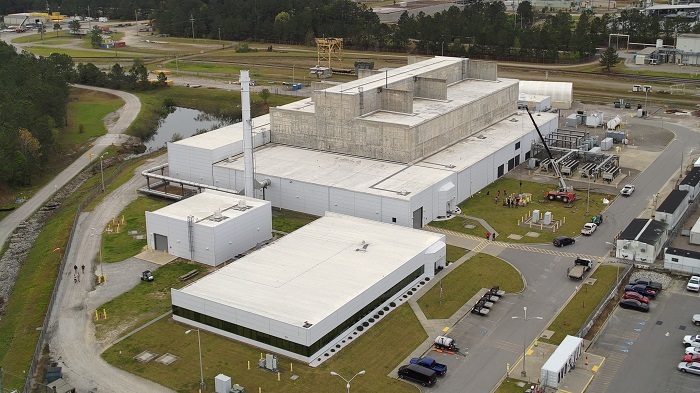
since 2008 through the work of three major facilities. To reach this milestone of 15 million gallons processed, SRS has
relied on the Salt Waste Processing Facility (SWPF) for the past three years, along with
the past performance of the Actinide Removal Process/Modular Caustic Side
Solvent Extraction Unit (ARP/MCU) and Tank Closure Cesium Removal (TCCR). Radioactive liquid waste is generated at SRS as byproducts from
processing nuclear materials for national defense, research, medical
programs, and for NASA missions. The waste — totaling 33 million gallons — is
stored at SRS in two groupings of underground waste tanks known as tank farms. Jim Folk, DOE-Savannah River assistant manager for Waste
Disposition, said waste is being safely removed from the aging tanks and the
site’s treatment of liquid waste is moving forward. “We are now processing more waste faster, further reducing the
risk to people and the environment,” he said.
In its first three years of operation, the Salt Waste Processing
Facility processed approximately 7.5 million gallons of tank waste,
significantly contributing to the liquid waste program’s output of 15 million
gallons of radioactive salt waste since 2008. In the fiscal year ending Sept. 30 last year, SWPF set a
single-year record by processing nearly 3.2 million gallons of radioactive
salt waste. This facility was the final piece needed to finish treating and
disposing of the liquid waste. SWPF separates and concentrates the highly radioactive waste —
mostly cesium, actinides and waste slurry — from the less radioactive salt
solution. The process begins by transferring the waste from H Tank Farm to
SWPF, where it undergoes a two-step cleanup process. The first step, known as the alpha strike, removes actinides,
such as uranium and plutonium, from the waste. The second step, known as
caustic side solvent extraction, is designed for the removal of radioactive
cesium. The decontaminated salt solution from SWPF is mixed with dry
materials to create a grout at the nearby Saltstone Production Facility (SPF)
for disposal onsite. The grout is pumped from SPF into Saltstone Disposal Units. There, the grout
solidifies into a monolithic, non-hazardous low-level waste form called
saltstone. Dave Olson, president and program manager of Savannah River
Mission Completion (SRMC), EM’s liquid waste contractor at SRS, said that
SWPF is now the facility in the SRS liquid waste program that will treat most
of the volume of the waste in the tanks. “SWPF operates at a much larger scale than earlier salt waste
processing facilities,” Olson said. “We continue to engineer improvements at
SWPF that we expect to help us achieve even greater production goals.” SWPF’s radioactive commissioning began October 2020. In its
first three years of operation, SWPF has safely processed nearly 7.5 million
gallons of tank waste. To reach these levels, optimizations were made to enhance the
facility’s existing design capabilities. These improvements are already
demonstrating that SWPF requires less downtime for maintenance, which means
more time for production. SRMC’s planned modifications will help boost the
system to process even greater quantities, moving toward the processing goal
of 9 million gallons each year. ARP/MCU Processes First Salt Batches The forerunner to SWPF was ARP/MCU, which began operations in
2008. ARP/MCU were designed as a demonstration project to show that salt
waste in the high-level waste tanks could be separated from the more
radioactive constituents. Although ARP/MCU were expected to operate temporarily, the
facilities performed well for 11 years before suspending operations in 2019
to prepare for startup of SWPF. During their lifetime, ARP/MCU processed 7.4
million gallons of radioactive salt waste. TCCR Supports Processing The TCCR project, which operated from fiscal year 2019 until the
project was suspended in 2022, consisted of a self-contained ion exchange
process for the removal of cesium from the liquid salt waste to provide a
supplemental treatment capability. TCCR removed cesium from more than 371,000
gallons of tank waste. The high-level waste constituents, such as cesium, must be
removed from the tanks before the tanks can be operationally closed and
removed from service. Cesium’s characteristics make it a top priority for
removal. -Contributor: Jim Beasley |