
“The illiterate of the 21st century will not be those who cannot read and write, but those who cannot learn, unlearn, and relearn.” -Alvin Toffler

Thursday, March 21, 2024

USDA Office of Inspector General. No harm in reporting fraud, waste, and abuse. March 2024


USDA OIG Investigations
Investigators from the USDA Office of Inspector General (OIG) collaborate frequently with other agencies to combat fraud, waste and abuse. Here are recent investigations in which USDA OIG played an integral part. More investigations.


USDA OIG Investigations - March 21, 2024


Tuesday, March 19, 2024

Earth just had its warmest February on record Northern and Southern Hemispheres had record-warm seasons

 Climate by the numbers

February 2024 | Season (December 2023 – February 2024)

The February global land and ocean surface temperature was 2.52 degrees F (1.40 degrees C) above the 20th-century average of 53.8 degrees F (12.1 degrees C), ranking as the warmest February in NOAA’s 175-year global climate record.

Looking how continents ranked, Europe, North America and South America had their warmest February on record, while Africa had its second warmest.

The three-month season (December 2023–February 2024) was the Northern Hemisphere’s warmest meteorological winter and the Southern Hemisphere’s warmest meteorological summer on record, with a global surface temperature of 2.45 degrees F (1.36 degrees C) above the 20th-century average. 

The year-to-date (January and February 2024) temperature currently ranks as the world’s warmest such period on record. There is a 45% chance that 2024 will be the warmest year in NOAA’s 175-year record and a 99% chance it will rank in the top five.
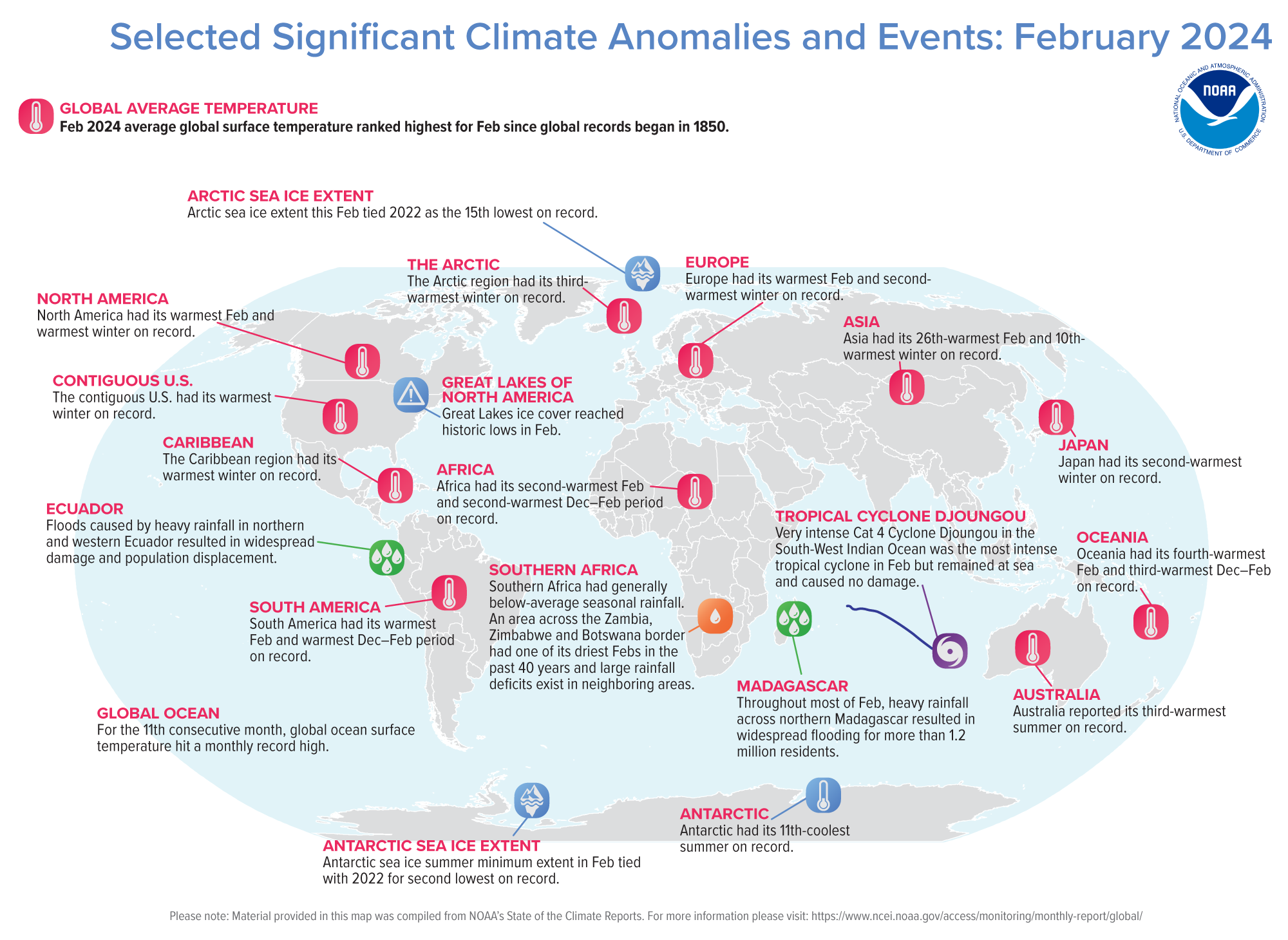
An annotated map of the world plotted with February 2024's most significant climate events. See the story below as well as the report summary from NOAA NCEI at http://bit.ly/Global202402.
An annotated map of the world plotted with February 2024's most significant climate events. See the story below as well as the report summary from NOAA NCEI at http://bit.ly/Global202402offsite link(Image credit: NOAA/NCEI)

Other notable climate events

Global sea ice coverage was sparse: Global sea ice extent (coverage) was the fourth smallest in the 46-year record, at 460,000 square miles below the 1991–2020 average. Arctic sea ice extent was slightly below average (by 100,000 square miles), whereas Antarctic sea ice extent was substantially below average (by 370,000 square miles), ranking second smallest on record.

Tropical activity was above average: Eleven named storms spun around the globe in February, which was above the 1991–2020 average of seven named storms. Only two storms made landfall, both bringing gusty winds to northern Australia. The only major tropical cyclone was Very Intense Tropical Cyclone Djoungou, which remained in the central Indian Ocean, well away from any major land masses. There were no active storms in the Pacific Ocean or the North Atlantic, but there was one weak tropical cyclone (Akara) in the South Atlantic, which is notable because atmospheric conditions usually inhibit tropical storm development in that basin.


More > Access NOAA’s latest climate report and download the images.

Webinar Registration: Global Summit on Extreme Heat Thursday, March 28 at 8:30 AM ET.


Please join the United States Agency for International Development (USAID) and the International Federation of Red Cross and Red Crescent Societies (IFRC) for the Global Summit on Extreme Heat, which will take place online on Thursday, March 28 at 8:30 AM ET.

2023 marked the hottest year on record, coinciding with deadly heat waves on nearly every continent, from Pakistan to Tunisia to Texas. Climate experts predict that extreme heat events will continue to increase in frequency, resulting in more lives lost and an increase in risk of other climate disasters such as drought and wildfires.

The Global Summit on Extreme Heat will bring together leaders and changemakers from across the world to discuss solutions and strategies to protect communities and workers from extreme heat. Speakers will include USAID Administrator Samantha Power, IFRC Secretary General Jagan Chapagain, and leaders from across the globe who are developing innovative solutions to lessen the impacts of extreme heat events and increase climate preparedness plans for all, saving lives and mitigating costs.

The virtual summit will be livestreamed and open to all.

Register here: usaid.link/heatsummit


Norooz / Nowruz (Persian: نوروز) means “new day”

Norooz, also known as the Persian New Year, is a vibrant and ancient celebration observed by various groups across the world.

·       Origins and Traditions:  

    • Norooz / Nowruz (Persian: نوروز) means “new day”. It is the biggest and oldest holiday in Iran. It takes a month of preparation and two weeks of celebrations. Norooz starts the new year at the exact moment when the sun crosses the celestial equator ending winter and welcoming spring. This year’s spring equinox is on Tuesday, March 19 at 11:06 PM EDT. Norooz has its roots in Zoroastrianism, the ancient religion of Persia founded by Zoroaster (a.k.a, Zartoasht). For over 3,000 years, Norooz has been celebrated across Western Asia, Central Asia, the South Caucasus, the Black Sea Basin, the Balkans, and South Asia. It symbolizes renewal, rebirth, and the triumph of light over darkness. 
  • Customs

v Khaneh-takani (House Cleaning): Weeks before Nowruz people clean the farthest corners of their houses and buy new clothes in preparation for the new year, spring, and visiting with friends and family.

v Chaharshanbe Suri: Zoroastrians believed fire is a cleanser and purifier. On the last Wednesday eve of the year people jump over bonfires to cleanse themselves of negativity and darkness, and desiring health and positivity.

v “Haft-Seen” Table Setting: Families prepare a Haft-seen Table, adorned with seven symbolic items, each starting with the Persian letter “S.” These include:

      • Sabzeh (sprouted wheat or lentils), Samanu (sweet pudding), Senjed (dried oleaster fruit), Seer (garlic), Seeb (apple), Somāq (sumac), and Serkeh (vinegar).
  • Visiting Relatives: For the first 12 days of the new year, families visit each other, share meals, and elders give-out “eidi” (presents); typically, from new, unfolded bills to gold coins.
  • Seezdah-bedar (13th day Outing): On the last day of the new year celebration, families fill the day outdoors with food, music, and dancing.

·     Global Celebrations:

    • Norooz is not limited to Iran; it is celebrated by diverse communities worldwide. Some of the countries where Norooz is observed include Afghanistan, Azerbaijan, India, Iraq, Kazakhstan, Kyrgyzstan, Pakistan, Tajikistan, Turkey, Turkmenistan, and Uzbekistan.
    • While it has become largely secular, Norooz remains a holy day for ZoroastriansBaháʼís, and certain Muslim communities. 

In summary, Norooz is a joyous celebration or rebirth and hope that transcends borders, uniting people in the spirit of renewal and optimism. If you get a chance this weekend, you may check-out Norooz celebration at the Smithsonian Institution. 🌼🌟🎉

Chaharshanbeh Suri


New Year Haft-seen Table Setting


New Year Celebration Around the world


Old painting depicting of Norooz celebration.

 Seezdah-Bedar


Norooz Mubarak (Happy New Year)


Popular Posts

ARCHIVE List 2011 - Present

Search This Blog

Environmental Justice

Recovery\Homeless Shelters. U.S.