“The illiterate of the 21st century will not be those who cannot read and write, but those who cannot learn, unlearn, and relearn.” -Alvin Toffler

Sunday, June 30, 2024

Webinar\Workshops: Disaster Risk Reduction and Early Warning Systems June 2024


Are you not able to see the email clearly?


 INVITATION 


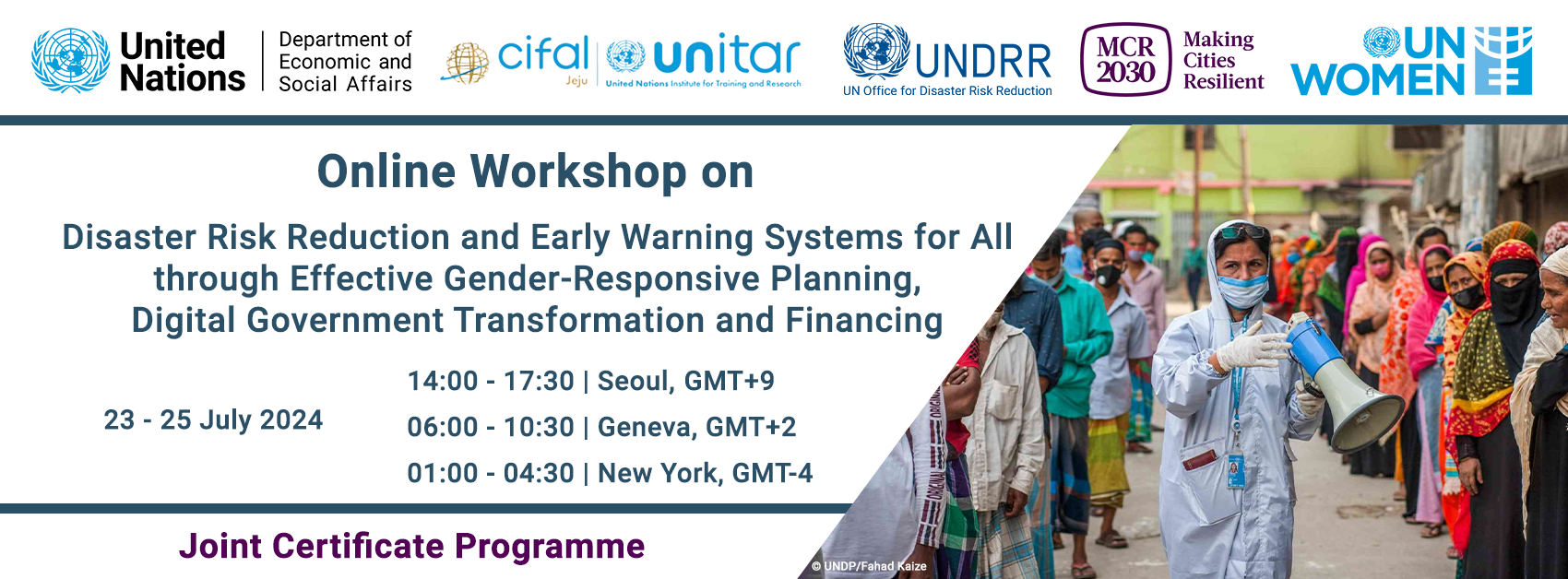
 2024 Joint Online Workshop on

Disaster Risk Reduction and Early Warning Systems for All

through Effective Gender-Responsive Planning,

Digital Government Transformation and Financing


Organized by:

UN DESA/DPIDG/United Nations Project Office on Governance (UNPOG)
United Nations Institute for Training and Research (UNITAR) CIFAL Jeju
UN Office for Disaster Risk Reduction (UNDRR) ONEA GETI
Making Cities Resilient 2030 (MCR2030)

UN Women Centre of Excellence for Gender Equality


We are delighted to invite you to join our joint online workshop!


Dear Madam and Sir,


Greetings from Jeju!

UNITAR CIFAL Jeju is pleased to announce the joint capacity building workshop on 'Disaster Risk Reduction and Early Warning Systems for All through Effective Gender-Responsive Planning, Digital Government Transformation and Financing', to be held from 23-25 July 2024 at 14:00~17:30 (Korean Standard Time, GMT+9).


July 23 (Tue) - 25(Thu), 2024 (ONLINE, Zoom)

PM 14:00-17:30 (Korean Standard Time, GMT+9)


Register by 11:59 PM, Monday, July 15, 2024 (KST)

Registration Link : https://bit.ly/2024drrwsregister


※ Please kindly note that we may close the registration earlier

if the number of registrations reaches the maximum capacity of the workshop seats.


Climate-related disasters have increased in terms of frequency and severity, causing a surge in economic and human losses, especially for low-income developing countries. Multi-hazard early warning systems and anticipatory action are central to saving lives and preventing injuries and losses. This workshop will explore how gender-responsive planning, digital government transformation and financing can contribute to ensuring effective disaster risk reduction and early warning systems.


Program


[Session 1 / July 23 (Tue) ]

Setting the Scene:

Disaster Risk Reduction and Gender-responsive Early Warning and Early Action 

- Understanding disaster risk, resilience, early warning

- EW4All Checklist and MHEWS scorecard

- Accelerating action for gender-responsive disaster risk reduction

- Designing gender-responsive early warning and action system


[Session 2 / July 24 (Wed) ]

Digital Government Transformation and AI for Early Warning Systems:

Accelerating Resilience and Gender-Responsive Sustainable Development

- Strengthening disaster risk reduction, EWS and resilience through risk-informed governance and frontier technologies

- Using Science, Technology, and Artificial Intelligence (AI) for Early Warning Systems

- Harnessing data and digital technologies for gender mainstreaming

- Data collection, analysis and use of Sex, Age, and Disability Disaggregated Data (SADDD) for gender-responsive DRR and early warning system

- IASC (Inter-agency Standing Committee) Gender and Age marker in the reflection from Nepal Country Experience


[Session 3 / July 25 (Thu) ]

Financing Framework for Disaster Risk Reduction and Early Warning Systems 

- Financing Disaster Risk Reduction - Integrated National Financing Frameworks (INFFs) Approach

- Readiness for Financing Early Warning Systems and Global Financial Initiatives to Achieve Early Warning Systems for All

- Financing gender responsive Disaster Risk Reduction and Early Warning Systems: highlighting from UNDRR Gender Action Plan, G20 Decision on Financing to DRR

- Introduction of the flagship programme Women’s Resilience to Disasters - a comprehensive framework to address gaps that the programme has identified and ways forward


*The above program is subject to change.


Certificate
UNITAR CIFAL Jeju/JITC, UN DESA/DPIDG/UNPOG, UNDRR ONEA & GETI and UN Women Centre of Excellence for Gender Equality will issue a joint E-certificate of Participation to participants upon successful completion and meeting all requirements* of the training.

*Requirements:
● Fully Attend all sessions (3 days) and submit attendance check forms respectively

● Actively participate in all sessions

● Submit the pre-workshop and post-workshop knowledge assessments 

Saturday, June 29, 2024

Water Security: What is the Role of Water in Rural and Urban School Facilities? June 2024


What is the Role of Water in Rural and Urban School Facilities?
STOCKHOLM INTERNATIONAL WATER INSTITUTE
The presence or absence of water in rural and urban landscapes is very much dependent on the hydrological cycle. Erratic rainfalls caused by climate change can create too much or little water for communities, affecting the availability of clean and safe water for drinking, sanitation, and hygiene.
Tackling the Global Water Crisis
THE GLOBE AND MAIL
The Center for Affordable Water and Sanitation Technology in Canada has an ambitious goal - to reach 100 million people by 2030 with better water, sanitation, and hygiene.
Securing cost-effective, sustainable water services for refugees, host communities in Eastern Africa
UNICEF
A decade of experience in Uganda and Ethiopia. 

Situation Awareness: HAITI. Sexual Violence. June 2024


ReliefWeb Headlines / 26 Jun 2024

Haiti: Sexual violence is being wielded as a weapon in Haiti’s humanitarian crisis

UNFPA – 26 Jun 2024

An estimated 578,000 people are displaced within the country, forced to abandon their homes and risking death, rape, kidnapping, and unsafe, overcrowded living conditions, says UNFPA. Read more

Funding Opportunity: $1.5 million Roddenberry Prize. Roddenberry Foundation. Deadline: July 12, 2024 (Letters of Intent)

Roddenberry Foundation invites LOIs for Roddenberry Prize

The Roddenberry Foundation invites letters of intent for the $1.5 million Roddenberry Prize, which supports early-stage ventures that leverage scientific breakthroughs or emerging technologies that hold the promise for a better future.
At the heart of the Roddenberry Prize is a belief that scientific and technological innovation will help us lead better, healthier, and more productive lives while helping the planet and our environment flourish. This year’s Roddenberry Prize is focused on AI and machine learning, and a grand prize of $1 million in non-dilutive financing will be granted to an early-stage venture that is using AI to improve the world. The Roddenberry Prize focuses on early-stage ventures that are ethical, world changing, AI driven, and scalable.
The prize application process will be conducted in three rounds: applicants may submit a letter of intent through July 12, 2024; a select number of applicants will be invited to submit a second-round application between August 5, 2024, and August 23, 2024; and five finalists will be invited to share their work and vision during a one-hour meeting with the foundation in October and November, 2024. One finalist will receive a $1 million grant and all finalists will be recognized publicly as “Roddenberry Prize Finalists.”

For complete program guidelines and application instructions, see the Roddenberry Foundation website.

Popular Posts

ARCHIVE List 2011 - Present

Search This Blog

Environmental Justice

Recovery\Homeless Shelters. U.S.