FEMA News

Co-hosted by FEMA’s
Voluntary Agency Liaisons and by the DHS Center
for Faith-Based and Neighborhood Partnerships, FEMA’s Individual
Assistance Division Leadership will present a webinar on Thursday, January
25, 2024, focused on Individual Assistance reforms.
Webinar Information:
- Topic:
Reforming Individual Assistance
- Date:
Thursday, January 25, 2024
- Time:
2:00 p.m. – 3:30 p.m. ET
Register in advance on ZOOM
and use the passcode “FEMAVAL” for access once the webinar begins. This
call will be supported by closed captioning and American
Sign Language (ASL).
Speakers:
Colt Hagmaier,
Assistant Administrator, FEMA Recovery Directorate
Marcus Coleman,
Director, DHS Center of Faith-Based and Neighborhood Partnerships
Frank Matranga,
Director, Individual Assistance Division
Dr. Elizabeth Asche,
Deputy Director, Individual Assistance Division
Zachary Usher,
Deputy Director, Individual Assistance Division
ICYMI: FEMA Reforms Disaster Assistance Program to Help
Survivors Recover Faster
Planned updates to FEMA’s Individual Assistance program
include quicker access to needed funds, expanded eligibility for property and
home repairs, and an easier application process for survivors to jumpstart
their recovery from disasters.
Secretary of Homeland Security
Alejandro N. Mayorkas and FEMA Administrator Deanne Criswell announced on
January 19, 2024 that FEMA is reforming its federal assistance policies and
expanding benefits for disaster survivors to cut red tape, provide funds faster
and give people more flexibility.
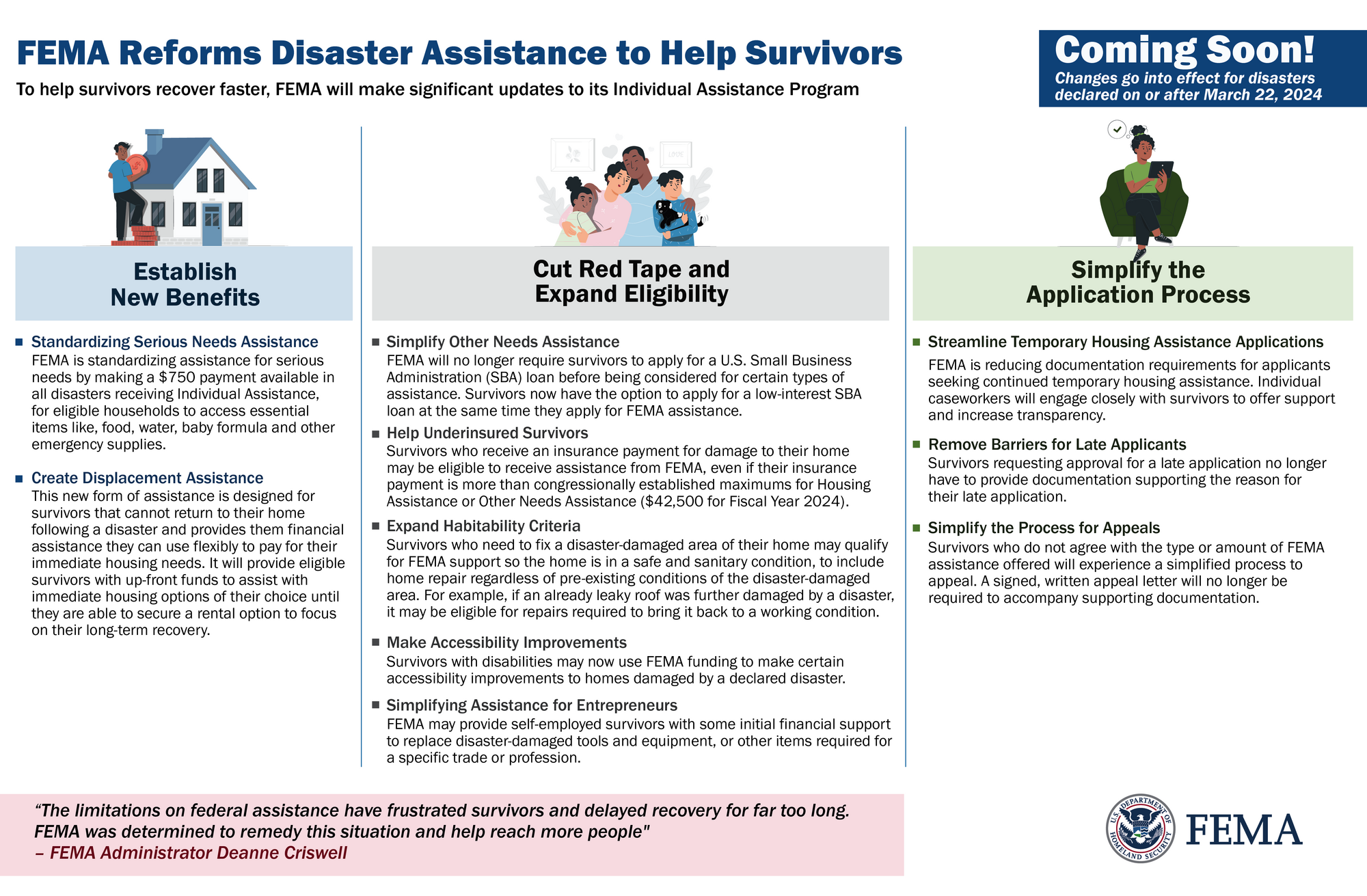
With the increased frequency of
extreme weather events fueled by climate change, these updates will provide
survivors with faster and easier access to resources they need after disasters.
FEMA developed these new forms of assistance based on direct feedback from
survivors and in response to the threats the nation faces due to our changing
climate; they will create more equitable outcomes for all communities by
increasing accessibility and eligibility for post-disaster support.
FEMA has been collecting feedback for decades from disaster survivors,
communities, and stakeholders, including from public comments the agency
solicited in 2021 on how to specifically improve the Individual Assistance
program. State partners and Members of Congress have echoed these concerns and
pressed for simpler, more straightforward programs to assist individuals across
the country as they recover. Those shared experiences serve as the foundation
of FEMA’s updates.
To benefit survivors,
FEMA will:
Establish new
benefits that provide flexible funding directly to survivors when they need it
most.
- Establishing Serious Needs Assistance: FEMA is standardizing immediate financial support for survivors by
replacing the Critical Needs Assistance program with a cash relief program
called Serious Needs Assistance. Previously only provided based on a
disaster-by-disaster evaluation, Serious Needs Assistance will now be
available in all disasters receiving Individual Assistance. The payment of
$750 for households with serious needs will help cover immediate expenses
related to sheltering, evacuation and meeting basic household needs. This
payment would be in addition to other eligible assistance that may be
provided to survivors based on their unique circumstances.
- Establishing Displacement Assistance: Recognizing the immediate housing needs for survivors after a
disaster, FEMA is creating a new benefit called Displacement Assistance.
This assistance is designed for survivors who cannot return to their home
following a disaster and provides them with greater flexibility in making
the best decision for their immediate housing needs. Displacement
Assistance will provide eligible survivors with up-front funds to assist
with immediate housing options of their choice, such as costs associated
with staying with family and friends, until they are able to secure a
rental option to focus on their long-term recovery.
Cut red tape and expand eligibility to reach more people and help them
recover faster, while building back stronger.
- Removing Loan Application Requirements: FEMA is removing the requirement that survivors apply for a U.S.
Small Business Administration (SBA) loan before being considered for
certain types of financial assistance. Previously, FEMA required survivors
apply for these loans before receiving assistance for personal property
and other non-housing losses. Survivors reported significant confusion
that FEMA processes required they apply for a loan they did not want. This
change will simplify the disaster assistance process and give survivors
the ability to apply for help from FEMA and SBA at the same time.
- Helping Underinsured Survivors: FEMA is streamlining insurance-related rules to help survivors who do
not receive enough assistance from their insurance company to cover their
rebuilding costs. Previously, if a survivor received $42,500 from their
insurance company (the 2024 maximum amount of money Congress authorizes
FEMA to provide for repairs), a household was ineligible to receive
additional assistance. It did not matter if the insurance payment would
not cover all rebuilding costs or if the survivor had losses not covered
by insurance. Under this amended approach, financial assistance is now
available up to the $42,500 cap, to cover costs not reimbursed by
insurance including deductibles and underinsured losses.
- Simplifying Assistance for Entrepreneurs: FEMA is simplifying the process so entrepreneurs, gig workers and
other self-employed individuals can more easily reopen their businesses
after a disaster. Previously, FEMA required self-employed individuals to
apply for an SBA disaster loan to cover all business losses. As a part of
the new regulations, FEMA may provide self-employed survivors with some
initial financial support to replace disaster-damaged tools and equipment,
or other items required for a specific trade or profession. This
assistance remains subject to the $42,500 maximum cap above which SBA
disaster loans will continue to provide additional federal support.
- Expanding Habitability Criteria: FEMA is simplifying its definition of “habitability” to broaden
eligibility to include repairs to homes with pre-existing conditions.
Previously, if a home had a leaky roof prior to a disaster, that area of
the home would not qualify for FEMA supported repairs. These changes mean
that survivors who need to fix a disaster-damaged home, may qualify for
FEMA support, to include home repair regardless of pre-existing
conditions, so the home is in a safe and sanitary condition. This change
eliminates current limitations that home repair assistance will be
provided only for components that ensure habitability and the requirement
that components were functional pre-disaster. It also expands eligible
hazard mitigation measures beyond essential components of a residence to
include the prevention of future damage to any disaster-damaged part of
the residence. Lastly, it confirms in regulation FEMA’s enhanced
flexibility on documentation that will satisfy proof a residence is
owner-occupied for those disaster survivors who do not hold formal title
or lease.
- Making Accessibility Improvements: Survivors with disabilities can use FEMA funding to make certain
accessibility improvements to homes damaged by a declared disaster. This
change helps survivors with disabilities improve their living conditions
by making their homes even more accessible than they were pre-disaster.
Previously, FEMA could only help with accessibility items directly damaged
by the disaster or that were not present before the disaster but are
required due to a disaster-caused disability.
Simplify the application process to meet survivors’ individual needs and
meet people where they are.
- Removing Barriers for Late Applicants: Recognizing the challenges already confronting disaster survivors,
those requesting approval for a late application no longer must provide
documentation supporting the reason for their late application.
- Streamlining Temporary Housing Assistance
Applications: FEMA is reducing documentation
requirements for applicants seeking continued temporary housing
assistance. Individual caseworkers will also engage closely with survivors
who continue to request assistance to ensure applicants have support
throughout their entire recovery process and have greater visibility on
when their rental support will end.
- Simplifying the Process for Appeals: Survivors who wish to appeal FEMA’s decisions on their eligibility
and will no longer need to provide a signed, written appeal letter to
accompany the supporting documentation.
FEMA expects the changes to take effect for new disasters declared on or
after March 22, 2024.
In addition to the planned updates, FEMA has already made the
DisasterAssistance.gov and Transitional Sheltering Assistance websites more
accessible and easier to navigate for survivors.
- Streamlining the DisasterAssistance.gov Website: New updates to the fully reimagined disasterassistance.gov website
have made applying for disaster assistance faster than ever. The online
application now provides survivors with easy navigation, visual progress
tracking, and individualized information collection. For example,
survivors now are only prompted to answer questions that apply to their
specific circumstances. This change will reduce time burdens for survivors
post-disaster, when they are in greatest need and the most overwhelmed.
For most disaster survivors, this change is expected to reduce the
registration time by more than 15%.
- Improving the Transitional Sheltering Assistance
Website: Survivors will find it easier to utilize FEMA's
Transitional Sheltering Assistance program to book lodging and contact
participating hotels directly to find temporary lodging solutions. Prior
to the updates, survivors would find an unfiltered list of lodging
options. Now, the website provides photos and user-friendly sort and
filter features. Updates have also been made to improve user experience on
mobile devices, making the process easier for survivors to navigate and
find lodging.
Contact Us
If you have any questions, please
contact FEMA Office of External Affairs:
Private Sector Engagement at (202) 646-3444 or
at nbeoc@max.gov