“The illiterate of the 21st century will not be those who cannot read and write, but those who cannot learn, unlearn, and relearn.” -Alvin Toffler

Saturday, September 27, 2025

Forensic Pathology. Science linking the past to the present and the cause. 1800's Maryland Cemetery to 2025 Mississippi Hangings.

Trust in Science, Investigating, trust in Forensic Pathology

Forensic Pathology (Click on preceding underlined link for AI and other searches) 

When did my search for truth, meaning, and interest in the science begin?  Was it in my studies at colleges and universities or during my adolescent and youth.  I always had a curiosity for things I didn’t know.  So, I’d say my interest in the sciences and investigating started before attending first grade in elementary school.  Staring out the window watching birds, animals, even airplanes flying in the sky.

Interest in technology, computer sciences in high school working at the National Science Foundation reading civil defense and other plans for nuclear attacks and recovery from that and other events.  Graduating from high school, registering as a pre-med student as my major.  Sitting in on my first autopsy at 19-years old at the old Washington, D.C. General Hospital.  Working in the pathology department at a local hospital in Maryland, understanding all the chemical and other tests performed on human specimens and taking that data and inputting into computer systems.  Understanding the process & procedures of human specimen collection, retention, and monitoring. 

Meeting and talking with the Chief Pathologist, Chief of Chemistry,  vendors of testing equipment, and understanding standards and standard organizations (national and international).  Confirming my trust in the sciences, in human sciences

In 2025, I can say there is one forensic pathologist that I have trust in that will remain nameless.

Investigating (Click on preceding underlined link for AI and other searches)

That interest and trust in the sciences led to other interest in the humanities and more readings in philosophies and literature for the truth. 

In reading all the Arthur Canon Doyle Sherlock Holmes series novels, and even all the PBS (Public Broadcasting Systems) television series.

Walter Mosely brought even more interest in the search for the truth and investigation with his Easy Rawlins series closer to home of a Black private investigator living in the Watts neighborhood of Los Angeles, California.

More to a lifelong interest in trust in the sciences and seeking the truth by investigating.

1800-1900’s Maryland Foster Care and 2025 Mississippi Hangings

Forensic pathology and investigating plays an important role in sorting thru facts and causes of death.

Archaeologist study the human past and make summations on even causes of death from human remains.  Forensic Pathologist and Archaeologist are linked in their investigative abilities to determine causes of death until a new method of determination of causes is evaluated and confirmed.

In the cases of the 1800-1900’s Secret Cemetery in Maryland (see photo and link below), and other ‘secret’ cemetery’s with First Nation\Native American foster care and youth facilities the truth must be told and the facts published.  Is this a call for the sciences, for forensic sciences to step-up and provide the truth?  YES

In the cases of the 2025 Mississippi hangings.  Historically hanging brings visions of the Wild West in America, criminal executions, and within the Black and other communities of color ‘lynching.   Hanging or Lynchings are not a one, two, three immediate process but involves being suspended and choking to death if the neck is not immediately broken.

There are questions in each of the cases that must be answered.  

  1. 1800-1900’s. A Secret Cemetery in Maryland.  https://www.facebook.com/reel/788404004060464
  2. 2025 Mississippi Hanging.  Trey Reed.  On campus at Delta State University
  3. 2025 Mississippi Hanging.  Cory Zukatis.  Vicksburg, Mississippi.


Forensic Pathology is the science needed to answer the questions that many of our members, members of the community, and the family in each case are awaiting. 

Respectful examination of the deceased, analysis of fluid and blood samples.  In 2025 those samples should be available.

Review of any and all camera footage, even examination of camera imaging AI of satellite imaging recorded (Mississippi GIS, https://www.gis.ms.gov/).Our search for the truth, the cause never ends. 

Our search for the truth, the cause never ends.

Sincerely

CDS


Wednesday, September 17, 2025

Funding Opportunity: Adapt, Micro-Grants harder to acquire. NYC. Impact 100 NYC invites applications from Big Apple organizations. Deadline October 29, 2025

Even with this opportunity for BIPOC nonprofits that baseline budget range (primarily consider organizations with an annual operating budget greater than $500,000) may be beyond the reach of many
 

Impact 100 NYC invites applications from Big Apple organizations

By harnessing the power of collective giving and collaborative action, Impact 100 NYC unites women across the five boroughs to fund transformative change that helps the people and communities of New York City overcome adversity and thrive.
 
Impact 100 NYC is accepting grant applications that propose an innovative new project or program, or a significant expansion of an existing program that will have a high impact or transformational effect on the community.
 
To be eligible, applicants must be classified as a public charity with tax-exempt status under section 501(c)(3) of the Internal Revenue Code since 2020 or prior; operate within the five boroughs of New York City for the benefit of local residents and communities; have a current annual operating budget between $500,000 and $5 million; can submit three years of CPA-audited or -reviewed financial statements (as required by New York State) and 990s for the most recent three years; and have no material pending litigation against the organization.
 
Applications for the 2026 grant cycle will open on September 29, 2025, with letters of inquiry due October 29, 2025. Invitations to submit full proposals will be sent by January 5, 2026, and full proposals are due on February 2, 2026.
 
For complete program guidelines, application instructions, and an eligibility quiz, see the Impact 100 NYC website.


AI: Funding Opportunity. Micro-Grants harder to acquire. OpenAI invites applications for People-First AI Fund. Closes October 8, 2025

"You have to act as if it were possible to radically transform the world. And you have to do it all the time.” —Angela Davis
 
Even with this opportunity for BIPOC nonprofits that baseline budget range (primarily consider organizations with an annual operating budget greater than $500,000) may be beyond the reach of many.
 
OpenAI invites applications for People-First AI Fund
 
September 11, 2025
 
Deadline: October 8, 2025
 
The mission of OpenAI is to ensure that artificial general intelligence—AI systems that are generally smarter than humans—benefits all of humanity.
 
OpenAI invites applications for the People-First AI Fund, a $50 million commitment to support nonprofits and mission-focused organizations working at the intersection of innovation and public good.
 
OpenAI welcomes applications from organizations at every stage of AI adoption—from exploration to pilots and active deployment. OpenAI recognizes that some of the most impactful opportunities may be new initiatives, approaches not yet been widely proven, or come from unexpected places.
 
The People-First AI Fund will support organizations directly working in three areas:
 
AI literacy & public understanding: OpenAI seeks to support organizations that help communities build the knowledge, skills, and confidence to navigate the age of AI. This includes education programs, media initiatives, and opportunities for people to engage with and better understand the technology. The company is particularly interested in efforts that equip people with practical skills. This may involve training trusted local leaders—such as educators, faith leaders, youth mentors, or artists—to make discussions about AI more accessible and relevant.
 
Community innovation: OpenAI aims to support organizations that work in partnership with communities to guide how AI might be shaped and used in their lives. The priority is to back efforts where communities lead participatory design and decision-making to ensure AI strengthens civic life and helps people stay healthy, connected, and thriving. This includes initiatives that use AI to expand access to and improve delivery of essential services, as well as community co-designed approaches in areas such as health, mental well-being, and building community trust. Priority consideration will be given to organizations working in place-based settings such as schools, libraries, clinics, or community centers; applicants that actively involve residents—including youth—in the design of initiatives; and efforts serving populations traditionally left out of digital innovation, such as older adults, rural communities, or linguistically isolated groups.
 
Economic opportunity: OpenAI seeks to support organizations expanding access to meaningful work in ways that are fair, inclusive, and community-driven by leveraging the promise of AI. This could include programs that prepare people—especially young people—for the jobs of the future; tools that support caregivers and local businesses; and initiatives that help workers build economic security. The company is also interested in models of shared value—such as cooperatives or community-based platforms—that respect local culture and center worker needs. Across all efforts, the company will prioritize approaches that enhance, rather than replace, human work and ensure the benefits of AI are broadly distributed instead of concentrated among the few.
 
Grants will be unrestricted, reflecting a commitment to support the expertise of nonprofit and community-based organizations.
 
To be eligible, applicants must be a U.S.-based public charity with a valid 501(c)(3) status, and in compliance with 501(c)(3) requirements; and must be located in, and primarily conducting work within, the 50 states or the District of Columbia. The company will primarily consider organizations with an annual operating budget greater than $500,000. All organizations must have an annual operating budget of less than $10 million. 

For complete program guidelines and application instructions, see the OpenAI website.

Link to complete RFP


Thursday, September 11, 2025

Disasterville. Get your community involved. October 2023


Disasterville

Disasterville is an interactive hands-on activity that supports preparedness program recruitment, encourages sponsor buy-in, helps as a great knowledge refresher and training tool, and is useful for preparedness education. Disasterville is useful for Community Emergency Response Teams (CERT), Medical Reserve Corps (MRC), and Voluntary Organizations Active in Disasters (VOAD), as well as local officials, Emergency Managers, professional responders, and the general public. Disasterville is designed as a table-top activity simulating a town set up with small buildings and figurines. The toolkit has markers to set up a disaster scene of your choosing, including infrastructure damages, structure damages, and victim conditions. This incorporates additional table top components such as an emergency operation center, a medical treatment area, and a hospital or healthcare area.

Disasterville is a Great Visual Tool

  • Show Elected Officials, Emergency Managers, and other community leaders how their city works without CERT and how using CERT can benefit response and recovery. This can help determine additional community needs, response gaps, and other ways that CERT can benefit the community.
  • Help individuals see the interchange and working relations between emergency management, professional responders, local health care providers, volunteer programs and community members.
  • Show community members possible first response limitations in the event of a major disaster, discover the importance of personal preparedness, and of being trained in basic disaster response skills.
  • Have CERT volunteers practice setting up and operating their CERT Organization/ Command Structure, using their documents, testing communication plans, gathering info and reporting it to the Emergency Operation Center for situational awareness, setting up a medical treatment area, triaging, and more.

Webinar on Disasterville

View recorded webinar here.

Presented by James Ray (Utah Division of Emergency Management) on 9/21/2021, as part of FEMA’s Preparedness Webinar Series, as a highlight from the 2021 National CERT Conference.

Create Your Own Disasterville Kit

Disasterville Toolkit

Download all the instructions and materials you will need to create your own Disasterville kit.

http://bit.ly/dvtoolkit

Disasterville eGame Stats

clock
Time:
15min to 2hrs
People
Players:
2 to 300+
Square
Space:
Table to Several Rooms
Gear
Low Tech
Money
Low Cost
Facilitators
Facilitators
1 or More

NCA Disasterville Activity Kit

CERT Programs across the U.S. have asked to purchase a pre-assembled Disasterville Kit. To meet this request, the NCA has partnered with the team in Utah to create pre-assembled Disasterville Activity Kits.

These kits will be available for purchase at the 2022 National CERT Conference.*

Want to buy a pre-made Disasterville Kit? Click here to let us know your interest by filling out a survey.

The NCA Disasterville Activity Kit will include the following:

  • Access to the electronic toolkit
  • Town style play mat
  • Wooden buildings / 32 piece town play set
  • Emergency vehicles (ambulance, police, fire truck, helicopter)
  • Matchbox cars (5)
  • Animal figurines (4)
  • People cut-out cards with victim conditions (66)
  • CERT character cards (12)
  • Building damage cards (40)
  • Healthcare facility profile and form (5 sets)
  • CERT forms (2 sets)
  • Position name plates (13)
  • ICS 214 activity log forms (14)
  • ICS 211 supply tracking form (14)
  • Infrastructure damage and hazards cards (66)
  • Medical treatment forms (66)
  • Mini medical treatment cards (66)
  • Search marking cards (40)
  • Storage box
  • Manila envelopes
  • Facilitator Guide with copies of all paper replacement parts (78 pages)
  • Facilitator checklist
  • Participant pre and post impact evaluations (20)
  • Participant exercise evaluation (20)
  • Facilitator evaluation tally sheet to measure impact
  • Access to the facilitator certificate of completion
  • Triage tarps = 1 set of 4 (8.5X11), and 1 small set of 4
  • Pens (10)
  • Zip style baggies to hold all cut out items
Disasterville is the result of a collaboration created in a cooperative effort by Will Lusk- Cache County Utah Emergency Management, Sandy Spendlove- State of Utah CERT Coordinator, Katie Hull- State of Utah and Weber-Morgan MRC Coordinator, Talisha Bacon- Utah County MRC Coordinator, Suz Roam- Southwest MRC Coordinator, and supported by James Ray- State of Utah Division of Emergency Management, and Stacy Sayre- HHS Region 8 MRC Liaison. Special Recognition to Logan City Utah Fire Department for the original creation of the Bradyville/Disasterville concept.


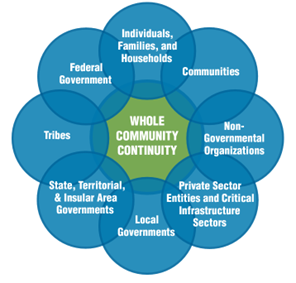
Training: Whole Community Training Available. Counterterrorism Operations Support (CTOS).

Consider 'whole community' training opportunities.

BEMA International

Popular Posts

ARCHIVE List 2011 - Present

Search This Blog