|

Friday, May 13, 2022
Black Renters Can't Afford 93% of Zip Codes In Top U.S. Cities: Report May 2022


Tuesday, May 10, 2022

National Day of Awareness for Missing and Murdered Indigenous Women and Girls
‘This is a U.S. problem:’
Families gather in Farmington to raise awareness about MMIWR
By Hannah Grover
Becky Martinez wipes away tears, Thursday, May 5, 2022, while talking about her brother, Calvin Martinez, who went missing about three years ago.
Rose Yazzie last spoke to her daughter, Ranelle Rose Bennett, in June of last year. They were talking about a birthday party for Bennett’s daughter, Yazzie’s granddaughter.
Yazzie recalls that her daughter hugged her for longer than usual. Looking back, she wonders if she missed the signs that something was wrong.
She hasn’t seen or heard from her daughter since, and Yazzie is frustrated with the lack of attention the police have given the case.
Bennett, Diné, is one of an unknown number of missing or murdered Indigenous people in New Mexico whose case remains unsolved.
Yazzie attended a rally on Thursday in Farmington to
raise awareness about the number of Native Americans who are missing or
murdered. This rally took place on the National Day of Awareness for Missing
and Murdered Indigenous Women and Girls and on what would have been Zachariah
Juwaun Shorty’s 25th birthday. He was murdered in July 2020.
His mother, Evangeline “Vangie” Randall-Shorty, Diné, was one of the organizers as she seeks information about her son’s death and who killed him.
“It’s heartbreaking. It’s a nightmare that I live every single day,” she said. “I carry this heaviness. And it’s like, there’s a hole in my heart, but it’s so damn heavy. It’s heartbreaking.”
Vangie Randall-Shorty talks about her son, Zachariah,
during a rally in Farmington.
She said she wants her son’s murderer caught and she wants to sit in the courtroom as the killer is sentenced.
“He was a fun-loving person,” she said about her son. “He wasn’t done because life was just beginning. He had a beautiful daughter who he loved very much. I love him. He loved me. I have no hesitation in expressing that.”
The group of primarily Native American families gathered on the side of San Juan Boulevard in Farmington outside of Berg Park and next to a billboard that, at times, displays information about two Native Americans who were killed and whose cases have not been solved. Shorty is one of those two people. Paying for that billboard took a concerted fundraising effort.
A woman with a megaphone called out “Justice for” and another person responded by shouting the name of a Native American who has gone missing or has been murdered.
Resources needed
Late last month New Mexico Attorney General Hector Balderas, surrounded by representatives of missing and murdered Indigenous individuals, spoke to the media about his frustration over a lack of legislative funding and resources to help the families of missing and murdered Indigenous women and men.
“Many have incomplete investigative work with next to no victim advocacy; they have no answers on where the status of their case is,” Balderas said
He also said he was implementing SB 12, which mandates the Attorney General’s office to create the position of a missing Indigenous person specialist.
But he said the bill was “not good enough and not strong enough.”
Balderas spoke of the jurisdictional issues that also plague missing and murdered Indigenous individuals which advocates have called a crisis.
Randall-Shorty said during Balderas’ press conference that her family had put up a $10,000 reward to help find the person responsible for her son’s death.
“There is a $10,000 reward that comes out of our pockets. We don’t have the resources and that’s what we need,” she said.
New Mexico releases response plan
The epidemic of violence that Indigneous people face led to the state releasing a response plan on Thursday.
“It is critical that we use every available tool to deliver critical resources to the loved ones of missing Indigenous women and relatives across New Mexico, bringing more awareness and public attention to these important cases and ensuring their families have the support they deserve,” Gov. Michelle Lujan Grisham said in a press release Thursday announcing the response plan.
New Mexico has the highest number of missing and murdered Native Americans in the country and two cities—Albuquerque and Gallup—are reported to have had more Native American women and girls go missing or be murdered in a five-year time frame than nearly 70 other urban centers in the United States, according to the introduction in the newly-released response plan.
A rally in Farmington raises awareness about missing and murdered Indigenous women and relatives.
The response plan calls for increasing support services to help people who are in crisis, developing community outreach programs as well as education and prevention strategies, developing resources so that when someone goes missing there can be a strong response, and building capacity within current systems, including the judicial system.
It also calls for creation of a memorandum of understanding between law enforcement agencies to facilitate better communication, including sharing of information, and establishing a MMIWR office that has a team tasked with investigating cold cases.
The plan also calls for inclusion of Tribal affiliation when documenting missing people, homicides or human trafficking cases.
Race and response
For Darlene Gomez, an attorney, these stories are all too familiar. Gomez has a dozen clients she represents who have missing or murdered relatives. She said she started on that path in 2001 after Betty Lee, Diné, was murdered. Gomez was an intern at the time. Robert Fry, a Farmington resident, was ultimately convicted and given the death sentence. He has also been convicted of several other murders. Fry is one of three New Mexicans on death row, having been sentenced prior to the state banning capital punishment.
Later one of Gomez’ friends, Melissa Montoya, would go missing. She remains missing to this date.
Gomez was part of the task force that worked to compile a state’s response plan that was released on Thursday. She described it as a good first step.
“This is not just a Native American problem,” she said during a speech at the rally. “This is a U.S. problem.”
She said race plays a role in the crimes remaining unsolved for years. Not all of her clients have been Native American. Gomez said when a white person went missing and she represented the white person’s family, there was greater attention from the media and the body was quickly found.
Some people at the rally mentioned the nationwide search that ensued when Gabby Petito, a white woman who was blogging about van life while traveling with her fiance, went missing. It didn’t take long for her body to be found. If that type of attention was given to the Native Americans who have gone missing, perhaps their cases could be solved as well, some people said.
Yazzie said if there had been that kind of response to her daughter’s disappearance, perhaps Bennett would already have been found.
Gomez said Petito’s disappearance brought more attention to the issue of people going missing, including Native Americans.
“I want people to know that these individuals murdered Indigenous men and women, they are you and they are me and their lives matter just like anyone else’s lives,” Gomez said. “They have mothers, they have siblings, they have children and no one is put on this earth to be killed.”
Having the day in court where they can face the person who killed their loved one is important to the families, Gomez said.
But it doesn’t fix everything, as Heaven Howland, Jicarilla Apache, pointed out. Howland’s brother, Travis Howland, was abducted, tortured and killed by their cousins. Their cousins were found guilty after a lengthy judicial process.
“Even though they catch the killers, your loved one
is still gone,” Howland said during a short speech she gave at the rally.
Susan Dunlap contributed to this report.
|
|
‘This is a U.S. problem:’
Families gather in Farmington to raise awareness about MMIWR Rose Yazzie last
spoke to her daughter, Ranelle Rose Bennett, in June of last year. They were
talking about a birthday party for Bennett’s daughter, Yazzie’s
granddaughter. Yazzie recalls that her daughter hugged her for longer than
usual. Looking back, she wonders if she missed the signs that something was
wrong. She hasn’t seen or […] nmpoliticalreport.com |

Thursday, May 5, 2022
Monday, May 2, 2022
India and Pakistan heatwave is 'testing the limits of human survivability,' expert says. CNN Mon May 2, 2022

India and Pakistan heatwave is 'testing the limits of human survivability,' expert says
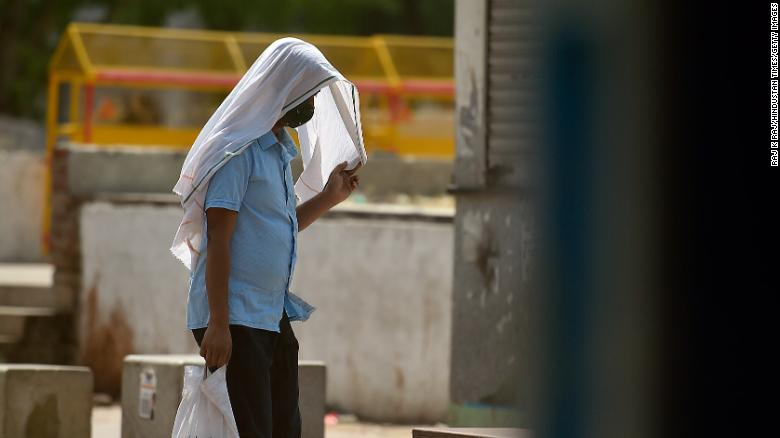
A pedestrian on a hot summer day at Connaught Place on April 30 in New Delhi, India.
Delhi (CNN)Temperatures in parts of India and Pakistan have reached record levels, putting the lives of millions at risk as the effects of the climate crisis are felt across the subcontinent.
The average maximum temperature for northwest and central India in April was the highest since records began
122 years ago, reaching 35.9 and 37.78 degrees Celsius (96.62 and 100
degrees Fahrenheit) respectively, according to the Indian Meteorological
Department (IMD).
Last
month, New Delhi saw seven consecutive days over 40 degrees Celsius
(104 Fahrenheit), three degrees above the average temperature for the
month of April, according to CNN meteorologists. In some states, the
heat closed schools, damaged crops and put pressure on energy supplies,
as officials warned residents to remain indoors and keep hydrated.
The
heatwave has also been felt by India's neighbor Pakistan, where the
cities of Jacobabad and Sibi in the country's southeastern Sindh
province recorded highs of 47 degrees Celsius (116.6 Fahrenheit) on
Friday, according to data shared with CNN by Pakistan's Meteorological
Department (PMD). According to the PMD, this was the highest temperature
recorded in any city in the Northern Hemisphere on that day.

People cool themselves in a canal in Lahore, Pakistan, on April 29.
"This
is the first time in decades that Pakistan is experiencing what many
call a 'spring-less year," Pakistan's Minister of Climate Change, Sherry
Rehman said in a statement.
Temperatures
in India are expected to subside this week, the IMD said, but experts
say the climate crisis will cause more frequent and longer heatwaves,
affecting more than a billion people across the two countries.
India
is among the countries expected to be worst affected by the impacts of
the climate crisis, according to the Intergovernmental Panel on Climate
Change (IPCC).
"This
heatwave is definitely unprecedented," said Dr. Chandni Singh, IPCC
Lead Author and Senior Researcher at the Indian Institute for Human
Settlements. "We have seen a change in its intensity, its arrival time,
and duration. This is what climate experts predicted and it will have
cascading impacts on health."
Loss of crops
India
often experiences heatwaves during the summer months of May and June,
but this year temperatures started rising in March and April.
In
the northern state of Punjab, known as "India's bread basket," that's
causing heat stress, not only for millions of agricultural workers, but
for fields of wheat they rely on to feed their families and sell across
the country.
Gurvinder
Singh, director of agriculture in Punjab, said an average increase of
up to 7 degrees Celsius (44.6 degrees Fahrenheit) in April had reduced
wheat yields.
"Because
of the heatwave we've had a loss of more than 5 quintal (500 kilograms)
per hectare of our April yield," Singh told CNN Monday.
Chandni
Singh, from the IPCC and no relation to Gurvinder Singh, said
agricultural workers were more likely to suffer from the oppressive
heat.
"People
who work outdoors -- farmers, those in construction, manual labor --
will suffer more. They have less options to cool down and can't stay
away from the heat," she said.

The Yamuna River on May 1 in New Delhi, India.
School closures and power cuts
In
some parts of India, demand for electricity has led to a coal shortage,
leaving millions without power for up to nine hours a day.
Last
week, coal stocks at three out of the five power plants Delhi relies on
to supply its power reached critically low levels, dropping below 25%,
according to Delhi's Power Ministry.
India
canceled more than 650 passenger trains through the end of May to clear
tracks for more cargo trains as the country scrambles to replenish coal
stocks at power plants, a senior official from the country's Railways
Ministry told CNN.
Indian Railways is a key supplier of coal to power plants across the country.

Some Indian states, including West Bengal and Odisha, have announced school closures to deal with the rising temperatures.
"Children
who have to traveled to school, many of them are getting nosebleeds,
they can't tolerate this heatwave," West Bengal's Chief Minister Mamata
Banerjee told reporters last week.
In
recent years, both the federal and state governments have implemented a
number of measures to mitigate the effects of heatwaves, including
shutting down schools and issuing health advisories for the public.
But according to Chandni Singh, more should be done to prepare for future heatwaves.
"We
don't have a heat action plan and there are gaps in planning," Singh
said. "You can only adapt so much. This heatwave is testing the limits
of human survivability."
Wednesday, April 27, 2022
Scholarship Opportunity. National Black Farmers Association
|
Scholarship Opportunity administered by the National Black Farmers Association for its 2022-2023 Next Generation of Black and Hispanic Farmers Scholarship Program! Please get your applications in soon, as the deadline date for this opportunity is May 15, 2022. For questions regarding this scholarship opportunity, please
contact Mr. John Boyd, Jr. at NBFA.Office@gmail.com,
or at (804) 691-8528. |
|
Black
Emergency Managers Association International Washington,
D.C. |
|
|||
|
First in the country: UNM offering online Chicano Studies MA program
by: Anna Padilla
Posted: Jan 5, 2022 / 06:00 AM MST
Updated: Jan 5, 2022 / 01:00 PM MST
ALBUQUERQUE, N.M. (KRQE) – University of New Mexico students now have the opportunity to get their online master’s degree in Chicana and Chicano Studies. It is the first program of its kind in the country.
Department Chair Dr. Irene Vasquez said UNM is ahead of most universities in providing ethnic studies degrees to both undergraduate and graduate students. “The academic purpose of Chicana and Chicano Studies is integral to the economic security and wellbeing of Mexican and Hispanic communities in the state of New Mexico,” Vasquez said.
Students study the historical, economic, and social realities of the Hispanic culture as it relates to the southwest United States. Students can expect to complete the degree anywhere from one year to two years time.
Anisa Baca is in her first year in the MA program. She said what drew her to the program was the opportunity to learn about her own heritage. “I think the program offers a lot of opportunity to support communities like mine,” Baca said. “I think it’s a really important option because I think it helps us understand ourselves, it helps us understand our communities, the needs of our communities, and I think when we do that, we can build something that benefits all of us.”
Not only will the program educate students on Hispanic history and culture, but Vasquez also said it helps them hone their skills in problem-solving, analytical reasoning, and communication through writing. Compared to last year, the department has seen 36% more applications to the program, which Vasquez said could also be due to the new online option.
The course is available for non-traditional and out-of-state students as well, something Vasquez is grateful for. “The online MA degree is available to anyone across the globe, but in particular we hope to reach our rural communities, our adults who are full-time workers or who are caring for young children in the home. We see that our online degree, even at the bachelor’s level, is serving those types of populations,” Vasquez said.
Howard Griego is a second-year MA student who transferred from CNM to pursue a master’s degree in Chicana and Chicano studies. “I fell in love with the program because I heard my story for the very first time. I heard my history of my state, of the people that I’m used to, and it was something that was new to me,” Griego said. “As a nontraditional student, having the online option makes it more accessible to people that are marginalized or people who live in rural communities.”
Through the in-person MA degree program, the department found that 80% of the students are from New Mexico. “That is a point of pride for us because as the research university of the state, we need to look locally. We need to look in the front and back and side yards of the university and bring our New Mexico students into graduate education,” Vasquez said.
In an effort to encourage state locals to learn about New Mexico’s history, the Chicana and Chicano Studies program has a series of pipeline programs through Albuquerque Public Schools to ensure high school students are prepared for college. The department works with them as they become UNM students.
Corky Frausto, a second-year Ph.D. student in the Chicana and Chicano Studies program, came into the program as a high school teacher who taught Mexican American studies. Through collaborations between the high school and the department, Frausto was inspired to delve deeper into the history and join the program at UNM.
Frausto continues teaching as part of his Ph.D. program. “I’ve seen the biggest impact with my students at the high school. They’re able to take dual credit classes, so they can take a class through the high school and earn credit here at UNM through the department,” Frausto said.
Vasquez said that anyone of any educational background can apply for the online master’s program. Visit UNM’s website for more information.
Copyright 2022 Nexstar Media Inc.Tuesday, April 26, 2022
Sign Up Now for National Council of Agricultural Employers (NCAE's) “Mitigating Heat Stress and Increasing Productivity” Webinar
register for NCAE's upcoming webinar, "Mitigating Heat Stress and Increasing Productivity," hosted by Bethany Boggess Alcauter, PhD.
The webinar is scheduled for Thursday, April 28th at 1:00 pm EDT/10:00 am PDT. Participants will be eligible to receive one Professional Development Credit from the Society for Human Resource Management upon completion of the webinar.
Please visit our website to learn more about the webinar. Attendance is limited so be sure to register while there is still space available!
Susan Lester
Manager of
Association Services

National Council of
Agricultural Employers
525 9th Street NW
Suite 800
Washington, DC 20004
202-910-8965
Cell
Thursday, April 14, 2022
Syracuse University Caribbean Student Association presents Disaster Preparedness in the Caribbean Tuesday, April 19, 2022 from 6pm – 8pm ET
Our
youth and the diaspora have a key role in addressing all issues of our
community from environmental, water & food security, financial, equity, to
the impacts of climate change.
Looking forward to seeing as many BEMA International members in attendance.
CDS
|
As natural disasters rise globally, communities of color continue to be directly impacted. Join us in conversation with Mr. Charles D. Sharp to learn more about disaster preparedness and how the Caribbean diaspora can get involved. There will be a Q&A session following the session where we encourage participants to ask questions and share their insights. Click here to register: https://syracuseuniversity.zoom.us/meeting/register/tJEkfu6hqTwvEt11QYlleXRl_wJphc3mAPx_ For more information, or if you require
accommodations, contact Lesley
Ells at ljells@syr.edu. |

|
Black Emergency Managers Association International Washington, D.C. 20020 |
|
|
bEMA International |
|
|
Cooperation,
Collaboration, Communication, Coordination, Community engagement, and
Partnering (C5&P) |
|
|
A 501 (c) 3 organization |
|
|
“We are now faced with the fact that tomorrow is today. We are confronted with the fierce urgency of now. In this unfolding conundrum of life and history there is such a thing as being too late. Procrastination is still the thief of time. Life often leaves us standing bare, naked and dejected with a lost opportunity. This may well be mankind’s last chance to choose between chaos or community.” Dr. Martin Luther King, Jr.,
‘Where Are We Going From Here: Chaos or Community’. |
Tuesday, April 12, 2022
Hot! Something even for a class group assignment. Complete Your Vulnerability Assessment for Your Facility Today!
No
matter what your organization does.
Complete a vulnerability assessment.
Menformation, Upward African Women, the FORCE (Syracuse, NY). Members in the Caribbean, Africa, and globally complete an assessment.
Be innovative. Mentors and student instructors, have your students perform a basic vulnerability assessment as a class group assignment by changed ‘house of worship’ to any organization, or even their home.
You may be surprised at what you find.
BEMA
International
|
Complete
Your Vulnerability Assessment for Your Facility Today! The
Department of Homeland Security Cybersecurity and Infrastructure Security
Agency has developed a baseline security self-assessment
that is designed for a person, with little to no security experience, to
complete a security assessment.  |
|
Black
Emergency Managers Association International Washington,
D.C. 20020 |
|
|
bEMA International |
|
|
Cooperation,
Collaboration, Communication, Coordination, Community engagement, and
Partnering (C5&P) |
|
|
A 501
(c) 3 organization
|
|
|
“We are now faced with the fact that tomorrow is
today. We are confronted with the
fierce urgency of now. In this
unfolding conundrum of life and history there is such a thing as being too
late. Procrastination is still the thief of time. Life often leaves us standing bare, naked
and dejected with a lost opportunity.
This may well be mankind’s last chance to choose
between chaos or community.”
Dr. Martin Luther King, Jr., ‘Where Are We Going
From Here: Chaos or Community’.
|
Subscribe to:
Posts (Atom)
Popular Posts
-
 François Ndengwe, INSP-Research Department Concept Note GEMOCIDE: TOWARD A SCIENCE OF RESPONSIBILITY IN T...
 -
Why get a new smartphone when it may only be a matter of clearing and transferring files to your tablet, laptop, or PC. Backup and storing p...
-
Have you forgotten the unsigned Contract with the Community . https://www.facebook.com/reel/865707402753460 ...


Environmental Justice

Recovery\Homeless Shelters. U.S.