“The illiterate of the 21st century will not be those who cannot read and write, but those who cannot learn, unlearn, and relearn.” -Alvin Toffler

Tuesday, July 13, 2021

Trust in Emergency Management. Spotlight. State of Michigan Emergency Management July 2021

  • Should Emergency Management be in control of State, County, or City Law Enforcement?
  • Is community participation and engagement lost?
  • Is trust fully established with the 'whole community', every member of the community?
  • The State of Michigan and the City of Detroit, and many other cities within the state (Flint, Dearborn, etc.) offer a unique observation for analysis for community engagement, participation, and funding opportunities.
  • Which communities are affected the most by ZIP CODE when disasters strike?

BEMA International

======================   
July 2021 SITUATION AWARENESS

                                                         Map of Detroit by WARD

.

FEMA Begins Process of Assessing Michigan Flood Damage

     Assessment teams are aware that the flooding has disproportionately impacted certain communities, so they will “also document specific characteristics” of each home, according to FEMA.

(TNS) - Local and federal government agencies are making their way around metro Detroit to as many homes affected by recent flooding as possible, talking to homeowners and recording data.

Several assessment teams made up of the Federal Emergency Management Agency ( FEMA), Michigan State Police-Emergency Management and Homeland Security Division, the U.S. Small Business Administration and Wayne County officials started walking down the streets Thursday of Dearborn, Dearborn Heights and Detroit, conducting preliminary damage assessments.

"We really are trying to gather information at this point," said FEMA external sffairs officer Troy Christensen. "We are knocking on doors, we're talking to the homeowners, to the renters, and seeing what kind of damage they had."....

..more Click on Link above

FUNDING 

State Administrative Agency (SAA) Contacts

The State Administrative Agency (SAA) is the only entity eligible to apply for and submit the application for the Homeland Security Grant Program (HSGP) and its component programs — State Homeland Security Program (SHSP), Urban Area Security Initiative (UASI), and Operation Stonegarden (OPSG) — as well as the Nonprofit Security Grant Program (NSGP).

Additionally, the SAA is one of two eligible entities allowed to apply for the Emergency Management Performance Grant (EMPG) (the state Emergency Management Agency is the other).

If you have a project you are interested in funding, please contact your applicable SAA POC.


Michigan:  Emergency Management Organization & Structure (County, Municipalities) 

          https://www.michigan.gov/msp/0,4643,7-123-72297_60152_66814---,00.html


Grant Opportunities: Washington, D.C. Deadline: Friday, July 30, 2021.


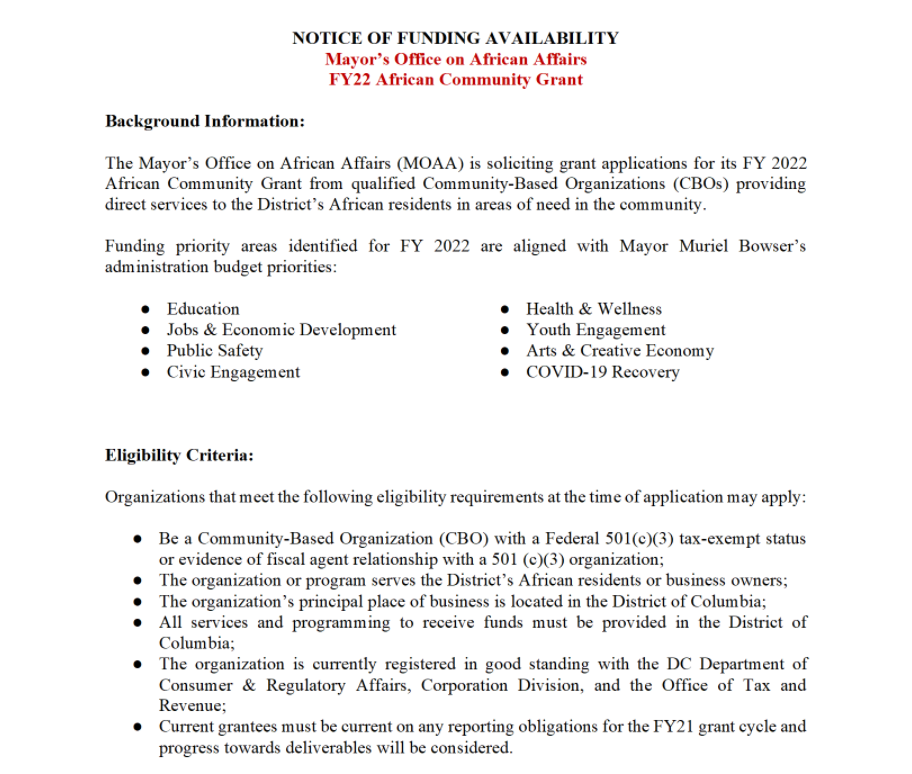
MOAA’s African Community Grant: Notice of Funding Availability (NOFA) 

acg

The Mayor’s Office on African Affairs (MOAA) is soliciting grant applications from qualified Community-Based Organizations (CBOs) serving the District’s African constituents for its FY22 African Community Grant. The African Community Grant is intended to fund programs that provide culturally and linguistically targeted services and resources to advance the District’s African residents community. 

Funding priority areas identified for FY22 are aligned with Mayor Bowser’s administration budget priorities:

  • Education
  • Jobs & Economic Development
  • Public Safety
  • Civic Engagement
  • Health & Wellness
  • Youth Engagement
  • Arts & Creative Economy
  • COVID-19 Recovery

The deadline for MOAA's African Community Grant is 5:00pm on Friday, July 30, 2021.

Submission Details: Online submissions only. Please submit your complete application through the following online portal: ZoomGrants

Availability of RFA: Download from the Mayor's Office on Community Affairs website and/or the District's Grant Clearinghouse website.

Learn more


Washington, D.C Grant Reviewers. July 2021


MOAA’s African Community Grant: Call for Reviewers

moaa

The Mayor’s Office on African Affairs (MOAA) is seeking volunteer grant reviewers to help evaluate the grant applications for the African Community Grant Program FY22. The reviewers are expected to be neutral, qualified individuals selected for their experience in one or more of Mayor Bowser's FY22 budget priorities: Education, Jobs & Economic Development, Public Safety, Civic Engagement, Health & Wellness, Youth Engagement, Arts & Creative Economy, and COVID-19 Recovery. 

The grant review period will take place from August 2, 2021 to August 7, 2021. This is a remote opportunity as the review will be conducted online (via zoomgrants.com).  

Requirements: 

  1. Previous grant reviewing experience with the DC or federal governments; private firms; or nonprofit organizations (preferred);
  2. Ability to evaluate and score review 3-4 proposals in a timely manner;
  3. Anticipate 20 – 30 hours for reviewing and evaluation.
  4.  Familiarity with technology.

If you intend to apply for the African Community Grant you will not be eligible to serve as a reviewer. 

This is a non-paid project. 

Interested individuals may submit a copy of resume to semhal.hagos@dc.gov by COB Wednesday, July 14, 2021. Please direct any questions to Semhal Hagos (semhal.hagos@dc.gov).

Role of Local Women in SDG Implementation. July 15, 2021. 9-10:30AM ET

 "The Role of Local Women in Accelerating SDG Implementation: experiences and challenges to ensure a resilient and inclusive COVID-19 recovery". 

The event will be held next July 15 from 8:00 to 9:30 Central American time. The event will feature panelists from the Americas & the Caribbean region. 

The event requires prior registration, please click  here: https://zoom.us/webinar/register/WN_jLT5WVSPSlmi24FndzV96A

Undercounted: Deaths in US Prisons. July 2021


COVID-19: mortality

Undercounted: Deaths in US Prisons


COVID-19 deaths of those incarcerated in the US may be significantly higher than the official total of about 2,700, according to a New York Times investigation that found dozens of deaths that went unrecorded.
 
Some deaths weren’t counted because prisoners had been released after becoming gravely ill while incarcerated. Others weren’t included for unexplained reasons. Prison officials said they shouldn’t be expected to count those who died after being released.
 
Public health experts warned that without knowing how many people died in prisons, jails, and detention centers, it’s hard for prisons, etc. to prepare for future epidemics.
 
New York Times


Related: 

Hundreds of medics urge US to step up pressure on Egypt over dire prison conditions – Middle East Eye

Kansas prisoners still can't have contact visits with loved ones. Health officials point to COVID-19 guidelines. – Topeka Capital-Journal

British Columbia, Canada. Lack of Emergency Preparedness.

 'It's not if, but when': B.C. fires expose Canada's lack of emergency preparedness, experts say – CBC

https://www.cbc.ca/news/canada/lytton-fire-climate-emergency-preparedness-1.6096370


Monday, July 12, 2021

Request for Proposals (RfPs) for various projects/studies to be conducted in CDRI member countries. July 2021

Coalition for Disaster Resilient Infrastructure (CDRI).

We are pleased to inform you that we have issued multiple Request for Proposals (RfPs) for various projects/studies to be conducted in CDRI member countries, on our website. Please find below the list of RfPs, their details and the last date of application. Interested and eligible agencies are encouraged to apply.  


S. No.

Projects/Studies

Request for Proposal Link

Last date of Application (Time: IST)

1.

Urban Disaster Resilience Study for Cuttack, Odisha

CDRI Urban Disaster Resilience Cuttack Study

30-07-2021/ 17:00:00

2.

Global Urban Infrastructure Resilience Study

CDRI RfP Global Urban Infrastructure Resilience Study

30-07-2021/ 17:00:00

3.

Risk and Resilience Assessment & Roadmap for Telecom Sector-India

CDRI RfP Telecom Sector Assessment

02-08-2021/ 23:59:59

4.

Global Case Study of Field Hospitals for COVID-19

CDRI RfP Field Hospitals Study

03-08-2021/ 23:59:59

5.

Global Study on Disaster Resilience of Airports – Phase 2

CDRI RfP Airports Study

30-07-2021/ 23:59:59

6.

Design, Development, and Operations of Disaster Resilient Infrastructure (DRI) Knowledge Portal

CDRI RfP Knowledge Portal Design, Development & Operations

02-08-2021/ 23:59:59

7.

State-Level Assessment of Fiscal Risks due to Disasters in Critical Infrastructure Sectors

CDRI RfP Fiscal Risks Assessment - State Level

29-07-2021/ 18:00:00

8.

National-Level Assessment of Fiscal Risks due to Disaster in Critical Infrastructure Sectors

CDRI RfP Fiscal Risks Assessment - National Level

29-07-2021/ 18:00:00

9.

Selection of Services for CDRI Resilient Infrastructure Marketplace – Design, Development, Marketing & Launch, Operations & Maintenance

CDRI RfP Marketplace Design, Development, Marketing, Launch, Operations & Maintenance


23-07-2021/ 17:00:00


For more information and to apply, please refer to: Tenders | CDRI


Africa's Business Economy & the AfCFTA - The Key Role of SMEs. 9am-11am (EDT), July 15, 2021

We Look Forward to Seeing! 

If you have not registered yet, please do! 

CLICK RIGHT HERE TO REGISTER for the FEEEDS-Gallup 8th Annual Africa Forum "Africa's Business Economy & the AfCFTA - The Key Role of SMEs," with partners ACBC, UPAC & US-Africa Trade Council. 

Honored Featured Guest Speakers are African Export-Import Bank's Dr. Hippolyte Fofack & AfCFTA Senior Advisor Dr. Francis Mangeni. 


Submit Advance Questions here: https://bit.ly/F-GQuestions


INVITE REMINDER – July 15, 2021 Virtual Event!


The 8th Annual FEEEDS-GALLUP Africa Forum

With Event Partners  allAfrica.comACBC,

UPAC & US-Africa Trade Council


“Africa's Business Economy & the AfCFTA -

The Key Role of SMEs”


2021 HONORED FEATURE SPEAKERS


Dr. Hippolyte Fofack 

Chief Economist, Director of Research & International Cooperation, African Export-Import Bank


Dr. Francis Mangeni

Senior Advisor to AfCFTA Secretary General


Magali Rheault - Data Scene Setter

Sub-Saharan Africa Regional Director, Gallup World Poll


AGENDA

Time & Date: 9am-11am (EDT), July 15, 2021

Time Zones: 3pm-5pm (Cairo/Joburg); 2-4pm (Lagos/London)


Co-Hosts

 Ambassador Robin Sanders, CEO-FEEEDS & Gallup Senior Scientist

Jon Clifton, Global Managing Partner, Gallup World Poll


Event Partner Leadership

Amadou Ba-allAfrica.com; Stanley Straughter-ACBC;

Sylvester Okere-UPAC & Titus Olowokere-US-Africa Trade Council


Annual Forum’s Objective: Highlight Africa topics with dialogue & data              


Click Here to REGISTER!

Hover over Speakers, Agenda, Co-Host & Event Partners for details & bios

Sunday, July 11, 2021

Science A Week After the Pacific Northwest Heat Wave, Study Shows it Was ‘Almost Impossible’ Without Global Warming July 2021


The extreme temperatures have shaken scientists’ fundamental understanding of heat waves and triggered concerns about a climate tipping point.

A couple and their dog lay in the shade during a heat wave in Portland, Oregon. on Monday, June 28, 2021. Credit: Maranie Staab/Bloomberg via Getty Images

A couple and their dog lay in the shade during a heat wave in Portland, Oregon. on Monday, June 28, 2021. Credit: Maranie Staab/Bloomberg via Getty Images

The high temperatures in late June that killed hundreds of people in Oregon, Washington and Canada were so unusual that they couldn’t have happened without a boost from human-caused global warming, researchers said Wednesday, when they released a rapid climate attribution study of the heat wave in the Pacific Northwest.

The temperatures were so far off the charts that the scientists suggested that global warming may be triggering a “non-linear” climate response, possibly involving drought magnifying the warming, to brew up extreme heat storms that exceed climate projections. 

Climate change, caused by greenhouse gas emissions, made the Pacific Northwest heat wave at least 150 times more likely, and increased its peak temperatures by about 3.6 degrees Fahrenheit, the study by World Weather Attribution concluded. 

“I think it’s by far the largest jump in the record that I have ever seen,” said Fredi Otto, a University of Oxford climate researcher and co-author of the study. “We have seen temperature jumps in other heat waves, like in Europe, but never this big.”

If global warming has pushed the climate past a heat wave tipping point, he added, “we are worried about these things happening everywhere.”

The Pacific Northwest heat wave should be a big warning, said co-author Dim Coumou, with the Institute for Environmental Studies at VU Amsterdam and the Royal Netherlands Meteorological Institute. It shows that climate scientists don’t understand the mechanisms driving such exceptionally high temperatures, suggesting “we may have crossed a threshold in the climate system where a small amount of additional global warming causes a faster rise in extreme temperatures.”

In an unrelated study published July 6, European Union researchers studying climate tipping points found additional evidence that human-caused warming could be “abrupt and irreversible,” partly because the current warming is so fast that the climate system can’t adjust. Even the “safe operating space of 1.5 or 2.0 degrees above present generally assumed by the IPCC might not be all that safe,” said co-author Michael Ghil, with the University of Copenhagen.

About 800 people died across the Pacific Northwest during the heat wave, a number that will probably still go up as officials examine medical records and statistics in the coming weeks and months. The peak temperature was 121.3 degrees Fahrenheit on June 29 in Lytton, British Columbia. After setting heat records for Canada on three consecutive days, the town was mostly destroyed by a wildfire driven by hot winds in the dried out forests nearby. In addition to contributing to several major wildfires in the region that are still burning, the heat cooked growing fruit and scalded foliage on trees and other vegetation

The European Union’s Copernicus Climate Change Service said Wednesday that the average June temperature was the highest on record for North America and the fourth-highest on record globally. In early July, extreme heat boiled over in northern Scandinavia, with parts of Finland reporting record-breaking temperatures. Persistent heat across northeastern Russia is fueling fires there that are emitting record levels of carbon dioxide for this time of year. And in the West, yet another spasm of dangerous heat is building, potentially peaking this weekend in central and eastern California.

The Deadliest Climate Extreme

Release of the attribution study of the Pacific Northwest heat wave coincided with other new research with dire heat warnings. 

A study led by Monash University scientists published Wednesday in The Lancet Planetary Health gives a comprehensive evaluation of heat deaths around the world from 2000 to 2019, a period when the global average temperature rose by nearly a full degree Fahrenheit. It attributes about 637,550 deaths during each of those years to high heat, including about 224,000 deaths per year in Asia, 78,000 in Europe and 19,000 in the United States. 

The high death toll in the Pacific Northwest was “sadly, no longer a surprise but part of a very worrying global trend,” said Maarten van Aalst, with the Red Cross Red Crescent Climate Centre and University of Twente, noting that heat waves were the world’s deadliest climate disasters in 2019 and 2020. 

In the U.S., heat is the leading weather-related killer, said Kristie L. Ebi, of the Center for Health and the Global Environment at the University of Washington. But with good planning, nearly all those deaths are preventable, she said. 

Communities need effective heat action plans that prepare for what are now completely unexpected heat extremes. Early warning and response systems, and community outreach programs, with neighbors checking on each other during heat emergencies, are among the best tools for saving lives, van Aalst said. There is also research showing that staff and scheduling changes at hospitals and ambulance services, based on extreme heat forecasts, can prevent deaths. 

Loading the Dice for Weather Extremes

The new attribution study bolsters previous warnings about the need to prepare for more extreme heat waves in a rapidly warming climate, said Otto, one of scientists working on the attribution study. The findings should be considered in the context of what societies are resilient to, and what they can adapt to, she said.

“This is not something you would plan for, or expect to happen,” she said. “The models of today are not a good indicator of what to expect at 1.5 degrees (Celsius) of warming. Most societies are sensitive to small changes, and this is not a small change, it’s a big change. We should definitely not expect heat waves to behave in the same way they have in the past.” 

Global warming has jacked up the odds for rare events, like 100-year floods, to happen every few years, said Carl-Friedrich Schleussner.

“We haven’t seen what a once in a 50 year event looks like now, in a climate altered by humans,” he said. “People are relating to those extreme events as really exceptional, and they are not. We are on the way to leaving the climate window of the Holocene, of the last 8,000 years where we’ve been enjoying a stable climate.”

Already, the world has warmed about 1.2 degrees from the pre-industrial average, he said, enough to fuel exceptional and dangerous heat extremes.

“It’s not really comprehended or understood what a climate change of 1.2 degrees is,” he said.

He warned that change is non-linear with global warming, meaning that a small rise of the average global temperature can spur a proportionately bigger increase in dangerous heat. Studies show that extremes like the 2003 European heat wave that killed about 70,000 people would have been nearly impossible without human caused warming and, with just another 1 degree Fahrenheit of warming, are likely to happen every other year by the 2040s.

“Our climate experience doesn’t prepare us to understand the scale of what’s going on,” he said. “People talk about loading the dice and throwing sixes. Global warming is loading the dice so we’re throwing sevens now, something impossible previously.”

BEMA International. "An Impossible Mission"? No July 2021

 BEMA International was conceived with a mission & vision that was considered impossible.

Is it?  No 

https://www.blackemergmanagersassociation.org/p/mission-vision.html


Popular Posts

ARCHIVE List 2011 - Present

Search This Blog

Environmental Justice

Recovery\Homeless Shelters. U.S.