“The illiterate of the 21st century will not be those who cannot read and write, but those who cannot learn, unlearn, and relearn.” -Alvin Toffler

Saturday, March 4, 2023

Food Insecurity: Haiti, Global Health, Farming, Nutrition. December 2021


December Newsletter 2021

Global Food Security Program

Highlight


Haitian Migration: Food Insecurity, Fragility, and a Better Way Forward
November 22, 2021
By Jamie Lutz and Erol Yayboke

Recent coverage of Haitians arriving at the U.S. border is only a snapshot of a years-long journey in search of safety and food security. A U.S. strategy toward Haiti must consider the links between hunger and migration and prioritize food security as a pillar of stability. 
Read the Commentary
 
Program Update 
GFSP and Reset the Table will be on a holiday break, and we will return in early 2022 with more research and analysis on food security. We hope you all enjoy a happy holiday season!

Analysis 


Photo: SIA KAMBOU/AFP via Getty Images
Read the Commentary
 
December 15, 2021
After UNFSS, How Should the U.S. Support Global Food Systems Transformations in Low-Income Countries? 
By Julie Howard
The UN Food Systems Summit marks a shift from heavily focusing on increasing agricultural production to a broader food systems approach to food security. What are the implications for Feed the Future and related U.S. assistance to low-income countries?

Photo: FREDERIC J. BROWN/AFP via Getty Images
Read the Critical Questions
 
November 10, 2021
Food Insecurity among Veterans: Who Is at Risk and How to Respond 
By Jamie Lutz, Caitlin Welsh
Existing policies and programs are no longer sufficient to support today's veteran population, and many veterans are going hungry. Policymakers should develop data-driven solutions to better address food insecurity for those at highest risk in the veteran community. 
 

Reset the Table Podcast

​GFSP's fortnightly podcast brings fresh ideas to the table for solving food insecurity around the worldand right here at home. Sign up for Reset the Table podcast updates at this link.
 

Reimagining Solutions to Antimicrobial Resistance with Anders Dalsgaard and Paul Plummer
December 9, 2021

Anders Dalsgaard (ICARS) and Paul Plummer (NIAMRRE), experts in antimicrobial resistance (AMR), join GFSP senior associate Kimberly Flowers to explore solutions to AMR in low- and middle-income countries. Dr. Dalsgaard and Dr. Plummer share global examples of previous successes in combatting AMR but note that sustained attention to the issue, and swift action, are required to meaningfully address this silent pandemic. Both experts stress that any solution must be context-specific and take into account the disparity in resources between developed countries and low- and middle-income countries to address AMR. 

Listen to the episode

Responding to the GMO Debate with Gregory Jaffe
December 3, 2021

Gregory Jaffe, director of the Project on Biotechnology at the Center for Science in the Public Interest, joins Caitlin Welsh in this episode to share his expertise on biotechnology in the U.S. food system and the relevant policies surrounding bioengineered crops, commonly known as GMOs. Mr. Jaffe and Ms. Welsh discuss the public perception and misconceptions of bioengineered foods. Mr. Jaffe emphasizes the importance of consistent policies for identifying and labelling these food products and explains how upcoming regulations from the National Bioengineered Food Disclosure Law may or may not resolve ongoing conflicts about GMOs.  

​​​​​​
Listen to the episode

Reaching Veterans, Bolstering Food Security with Shelley MacDermid Wadsworth
November 10, 2021

In this episode, Purdue's Military Family Research Institute director Shelley MacDermid Wadsworth and CSIS Global Food Security Program director Caitlin Welsh discuss food security in the military community. Dr. MacDermid Wadsworth describes the various causes and stressors that are unique to veterans experiencing food insecurity, especially veterans living in rural areas. Dr. MacDermid Wadsworth and Ms. Welsh offer potential solutions to food insecurity among the veteran community and discuss the role of food pantries in responding to immediate food security needs. Dr. MacDermid Wadsworth also underscores the importance of collaboration among policymakers and researchers to address food security for current and future veterans.

Listen to the episode
 

Affiliates in Action

Andrew Rzepa

Senior Associate (Non-resident), Andrew Rzepa

Tools for Monitoring Diet Quality Across Countries (Nutrition for Growth Summit Side Event): 
December 9, 2021

This event is the official launch of a set of over 100 country-adapted diet quality questionnaires that enable diet quality monitoring by countries and programs. Andrew Rzepa discussed implementation in global multi-topic surveys.
Read the event details

Katrin Kuhlmann

Senior Associate (Non-resident), Katrin Kuhlmann

Listening for America: Cathy Novelli on Globalization and International Trade 
December 1, 2021

Katrin Kuhlmann joined this discussion on Listen for America's findings and recommendations for establishing a more inclusive international trade policy and whole-of-government approach to dealing with those adversely affected by international competition.
Read the event details

Julie Howard

Senior Adviser (Non-resident), Julie Howard

Agriculture and Working Development Group of the Scaling Up Community of Practice: 
November 16, 2021

Julie Howard co-chaired the Agriculture and Rural Development Group of the Scaling Up Community of Practice and organized a three-part panel discussion series on scaling. The discussion series explores how our understanding of scaling has evolved in recent years, and asks how concepts, tools, and capacities may need to change further as we transition from a focus on agricultural productivity to the new food systems framework. Dr. Howard co-moderated the first panel on November 16, "Scaling and Transforming Food Systems." 
Watch the event

GFSP in the News

November 1, 2021
Lawfare:
The Week That Will Be

By Emily Dai
GFSP's November 5 event on AMR and Climate Change was highlighted as a notable event in Lawfare.

Read the article
November 2021
USAID Advancing Nutrition:
Multi-Sectoral Nutrition Resource Review

By USAID Advancing Nutrition
Our Reset the Table episode "Reviewing the UN Food Systems Summit with Agnes Kalibata" is featured in the Knowledge Management section. 
View the resources
November 15, 2021
War on the Rocks:
To Tackle Instability and Conflict, It's Time to Elevate Hunger as a National Security Priority

By Kelly McFarland and Alistair Sommerville
Senior associate Rod Schoonover is quoted in this article calling for a more sophisticated conception of national security.
Read the article

Past Events

​​​​​​Public Event: The Impact of Climate Change on Antimicrobial Resistance in Low- and Middle-Income Countries
November 5, 2021
Some recent research indicates that rising global temperatures will accelerate the rate of antimicrobial resistance (AMR), making the case for implementing effective AMR policies in conjunction with comprehensive climate policy. The CSIS Global Food Security Program gathered experts on climate and AMR to discuss how health, climate, and agriculture policies are interconnected and the need for transdisciplinary integration of development practices and policies in low- and middle-income countries (LMICs). Watch our recent event for a discussion on the implications of climate change for AMR and how to develop integrated AMR initiatives in LMICs. 
Watch here​​​

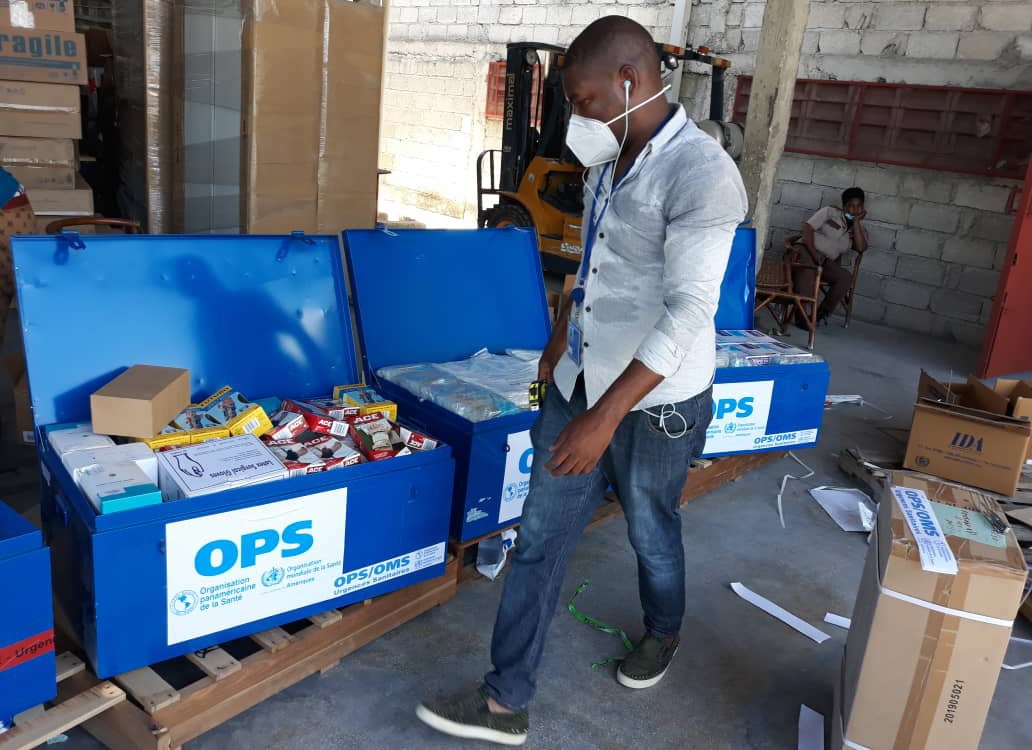
PAHO deploys experts to support Haiti during earthquake aftermath. 14 Aug 2021

https://www.paho.org/en/news/14-8-2021-paho-deploys-experts-support-haiti-during-earthquake-aftermath


PAHO deploys experts to support Haiti during earthquake aftermath

14 Aug 2021
Port au Prince, August 14, 2021. A team of experts from the Pan American Health Organization’s (PAHO) office in Port au Prince has been deployed to evaluate damage and coordinate an appropriate health response following the 7.2 magnitude earthquake that shook Haiti on the morning of Saturday August 14.
Emergency medical teams and other supplies and equipment will be prepared to help meet the most urgent health needs of those affected by the 7.2 magnitude quake.

Latest reports from the Haiti Civil Protection Agency suggest that at least 227 people have been killed – a number which is expected to rise over the next few hours. There are also reports of significant damage to health infrastructure, particularly in the southwest of the island, including in towns such as Les Cayes.
Our hearts go out to the people of Haiti on this truly sad day,” said PAHO Director, Dr. Carissa F Etienne. “Our team of experts is on the ground and stands ready to assist in all aspects of health response,” she added.
The team from PAHO is supporting coordination of health response alongside Haiti’s Ministry of Health, UN agencies, and other partners in order to assess immediate needs and ensure that support is provided quickly and efficiently. PAHO is also preparing several Emergency Medical Teams (EMTs), as well as medical supplies and other strategic equipment that can be deployed if needed. EMTs are teams of health professionals that provide direct clinical care to people affected by emergencies and disasters.
Distribution of supplies
PAHO/WHO has activated Incident Management Teams both at its Country Offices in Haiti and the Dominican Republic as well at its Headquarters in Washington, DC, USA.
Experts are now concerned that the situation may escalate due to the increased risk of wind and rainfall that may be brought by  tropical storm Grace, which is expected to reach the Hispaniola island on Sunday August 15.  

Contacts 

Daniel Epstein 
Nancy Nusser 
Sebastián Oliel
Ashley Baldwin 
Nadia Peimbert-Rappaport 

Communities affected the most? Haiti, Cuba, South Africa, Vulnerable Communities of Color. July 2021


Jul 12, 2021

GHN News


Soldiers patrol during a protest following the assassination of Haitian President Jovenel Moise. Port-au-Prince. July 08, 2021.
Image: Richard Pierrin/Getty


Covid-19 and Countries in Turmoil


Haiti: Doctors Dodging Bullets
 
Street violence and COVID-19 are surging amid growing concerns that reactions to President Jovenel Moïse’s assassination last week may disrupt delivery of medical supplies, reports The Washington Post.

  • Patients are afraid to travel to the hospital; and “dodging bullets has become routine” for health workers


  • People displaced by the gunfire are filling crowded shelters heightening transmission risk. 

Worse news: Haiti hasn’t vaccinated a single person, Rashmee Roshan Lall writes in an openDemocracy commentary.


South Africa Protests
 

Several people have been killed in protests over the jailing of former President Jacob Zuma, the BBC reports, and police arrested dozens people over the weekend for public violence and violation of COVID-19 lockdown regulations, Al Jazeera reports.

  • President Cyril Ramaphosa warned yesterday that  COVID-19 infections “remain extremely high” and pledged to keep restrictions in place through July. (Medical Xpress).
  • Emergency rooms have been overwhelmed by an “onslaught of patients” in the country’s third wave, described in a CNN video.


‘Worst Days’ for Cuba
 
Cubans are taking to Havana’s streets to protest economic conditions and the slow roll-out of COVID-19 vaccinations, ABC Australia reports.

Hope: Cuba’s 3-shot homegrown Abdala vaccine received local regulatory approval on Friday for emergency use.

Related:
 
Big step towards vaccine security for South Africa while country remains on Level 4 lockdown – Daily Maverick
 
COVID: Cuba approves emergency use of own Abdala vaccine – Deutsche Welle

Friday, March 3, 2023

$350 million funding opportunity for the Emergency Food and Shelter Program (EFSP) National Board

The Department of Homeland Security announced a $350 million funding opportunity for the Emergency Food and Shelter Program (EFSP) National Board to fund the humanitarian portion of the Emergency Food and Shelter Program (EFSP-H). This humanitarian funding is designed to support local governments and organizations as they assist migrant families and individuals encountered by the U.S. Department of Homeland Security at the southern border.

Beginning March 6th, the National Board, with support from FEMA, will host a series of webinars for potential applicants of EFSP-H funds to explain how to apply, discuss any changes from the previous year’s application guidance, and provide answers about the application process. 

Six webinars will be offered using the Zoom platform.

·        Time: 4 - 5 p.m. EST

·        Date: March 6, 2023

·        Register to attend

·        Zoom Meeting ID: 160 818 5677

·        Passcode: EFSP


·        Time: 3 - 4 p.m. EST

·        Date: March 9, 2023

·        Register to attend

·        Zoom Meeting ID: 161 762 3859

·        Passcode: EFSP


·        Time: 10 – 11 a.m. EST

·        Date: March 13, 2023

·        Register to attend

·        Zoom Meeting ID: 160 273 4542

·        Passcode: EFSP


·        Time: 10 - 11 a.m. EST

·        Date: March 16 2023

·        Register to attend

·        Zoom Meeting ID: 160 472 0184

·        Passcode: EFSP


·        Time: 1 - 2 p.m. EST

·        Date: March 21, 2023

·        Register to attend

·        Zoom Meeting ID: 161 485 1532

·        Passcode: EFSP


·        Time: 3 - 4 p.m. EST

·        Date: March 23, 2023

·        Register to attend

·        Zoom Meeting ID: 160 486 4232

·        Passcode: EFSP

Participants must use the above registration links and pre-register to attend the webinars. Once participants have registered, they will automatically receive an email confirmation containing information for accessing the webinar – including a calendar invite that can be saved and options for attending by audio.

NIEHS Superfund Research Program (SRP) is hosting a Progress in Research webinar series. 11 new and renewed Multiproject Center grantees funded in 2022

NIEHS Superfund Research Program (SRP) is hosting a Progress in Research webinar series to showcase the research from 11 new and renewed Multiproject Center grantees, funded by SRP in 2022. 


In the four-part series, new Centers will highlight their proposed research projects, and returning Centers will cover previous accomplishments and proposed next steps for their renewed grant.


The webinars are free and open to the public. Registration is now open for all four sessions:


April 28, 12:00-2:00 p.m. EDT

The first session will feature the Texas A&M University and Michigan State University SRP centers, as well as the newly funded SRP Center at Yale University.


May 5, 12:00-2:00 p.m. EDT

The second session will highlight the University of New Mexico SRP Center and the newly funded Columbia University Northern Plains SRP Center.


May 12, 12:00-2:00 p.m. EDT

The third session will feature the Massachusetts Institute of Technology, University of California, Berkeley, and University of Rhode Island SRP centers.


May 19, 12:00-2:00 p.m. EDT

The fourth and final session will highlight the Duke University and University of Louisville SRP centers, as well as the newly funded SRP Center at Wayne State University.


If you are unable to attend live, an archive will also be available on the Progress in Research webpage shortly after each session.


Popular Posts

ARCHIVE List 2011 - Present

Search This Blog