Event language(s)
- Arabic
- Chinese
- English
- French
- Russian
- Spanish
Date and time
11 October 2023
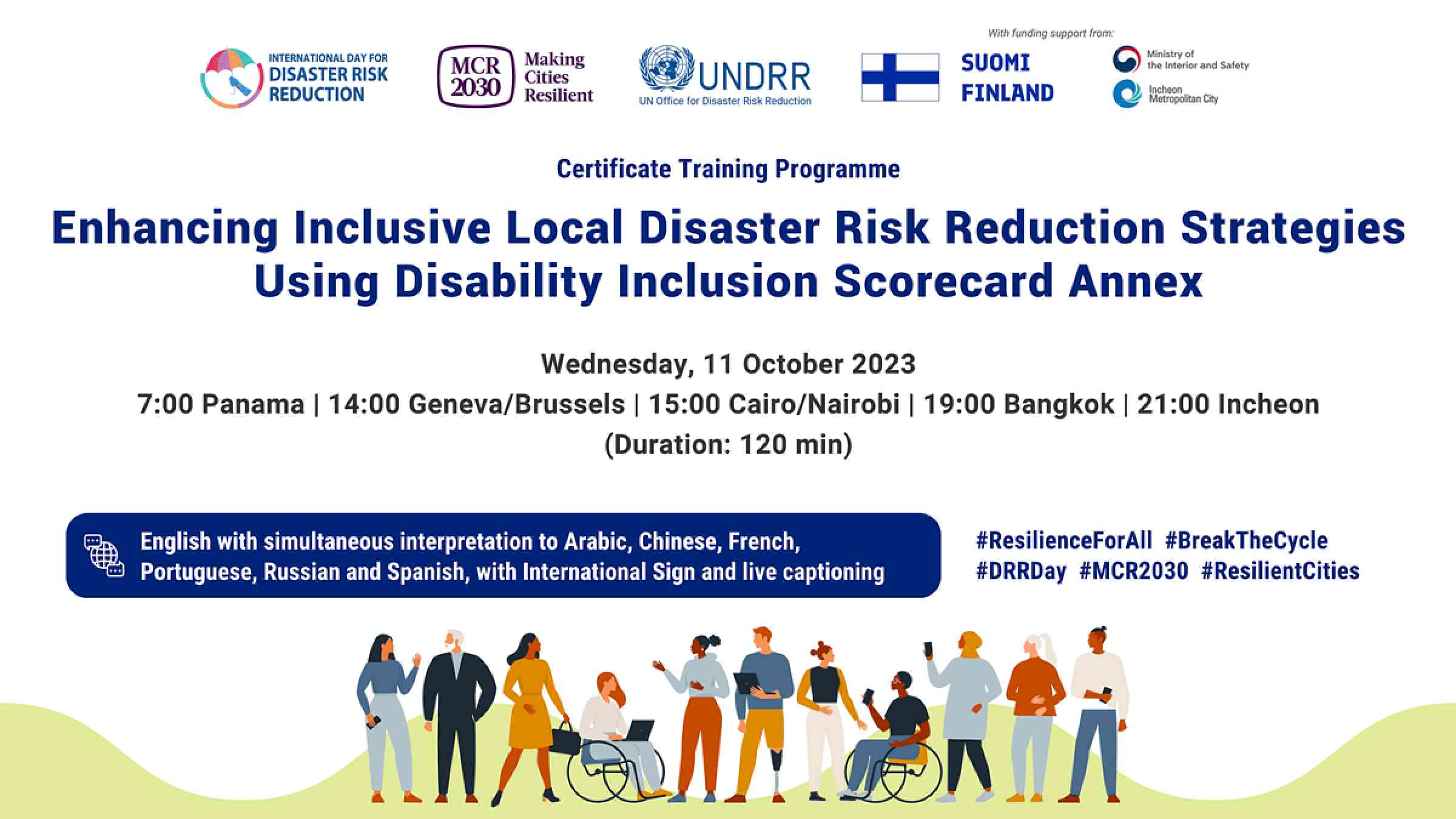
7:00 Panama | 14:00 Geneva/Brussels | 15:00 Cairo/Nairobi | 19:00 Bangkok | 21:00 Incheon
(Duration: 120-min session)
Training language
English with simultaneous interpretation to Arabic, Chinese, French, Portuguese, Russian and Spanish, as well as International Sign and live captioning in English
Course background
Due to physical, mental, social, and systemic barriers, persons with disabilities experience the effects of disasters disproportionately, contributing to their varied levels of resilience and capacities for response and recovery. Many persons with disabilities face social and logistical isolation, impeding their access to evacuation warnings, appropriate transport facilities, caregivers, and any essential medical equipment. An estimation by WHO, there are approximately 1.3 billion people experience significant disabilities worldwide. Despite this substantial figure, only about 15% of these individuals have participated in disaster management and risk reduction initiatives within their communities (UNDRR, 2013).
2023 marks the midpoint in the implementation of the Sendai Framework for Disaster Risk Reduction 2015-2030, which reflects a human rights-based sustainable development approach inclusive of and accessible to all communities, including persons with disabilities. The Mid-Term Review of the Sendai Framework stresses the criticality of adopting a whole-of-society approach for the implementation of inclusive DRR. It underscores the urgency of involving all segments of society, including the often-overlooked individuals with disabilities, in disaster preparedness, response, and recovery efforts. The review highlights the importance of removing systemic, social, and logistical barriers that often leave persons with disabilities disproportionately vulnerable to various hazards and further advocates for their active participation in community-level DRR processes, reiterating the Sendai Framework's call for inclusivity and resilience for all. The review is a strong reminder that for the DRR strategies to be effective and robust, they must reflect the diverse needs and capacities of all members of society.
Launched in December 2022, the Disaster Resilience Scorecard for Cities - Annex for the Inclusion of Persons with Disabilities aims to support local governments in enhancing the capacity to develop and implement inclusive DRR strategies. It is a tool for which local governments can use in evaluating the current disaster risk management practices, and can further design, formulate and implement more inclusive disaster risk reduction policies. It aims to incorporate persons with disabilities as an integral part of the development of local strategies and to promote inclusion and accessibility in the urban environment, so that no one is left behind. Responding to the call of UN Secretary-General Antonio Guterres and the adoption of the UN Disability Inclusion Strategy in June 2019, the Scorecard Annex for the Inclusion of Persons with Disabilities addresses considerations for the inclusion of persons with disabilities based on the Ten Essentials for Making Cities Resilient that were designed to support the implementation of the Sendai Framework at the local level, such as the inclusion of persons with disability in disaster risk governance, urban development and design, infrastructure resilience, and recovery and rehabilitation.
This training on Enhancing Inclusive Local Disaster Risk Reduction Strategies Using Disability Inclusion Scorecard Annex is organized in response to the Mid-term Review of the Sendai Framework and the International Day for Disaster Risk Reduction 2023 which underscore the pressing need to address the inequalities embedded in DRR practices and calls for re-examination of our current DRR strategies. Contributing to the Making Cities Resilient 2030 (MCR2030) initiative, the training is organized by UNDRR Global Education and Training Institute (GETI) with the support of the Government of Finland and the Government of the Republic of Korea (Ministry of the Interior and Safety and Incheon Metropolitan City).
Course objective:
- Raise awareness on the inclusion of persons with disabilities in disaster risk management
- Introduce the Disaster Resilience Scorecard for Cities – Annex for the Inclusion of Persons with Disabilities and its application for enhancing sub-national disaster risk reduction planning and implementation
Prerequisite:
There are no pre-requisites for this training course, but prior knowledge on the Ten Essentials for Making Cities Resilient and the Disaster Resilience Scorecard for Cities may be beneficial.
Expected learning outcome:
Participants understand the importance of accessibility and inclusion of persons with disabilities in disaster risk management.
Participants can learn, become familiar and use the Disaster Resilience Scorecard for Cities – Annex for the Inclusion of Persons with Disabilities to assess and enhance city’s disaster risk reduction planning and implementation.
Targeted participants
The course is open for any interested participants especially local governments, stakeholders, and urban resilience practitioners, all stakeholders including persons with disabilities. Seats are limited to 1,000 participants.
Course pedagogy:
The training will be held online via Zoom.
The training will include presentations, online polls and quizzes.
Disclaimer: For the purpose of this event, UNDRR procures the services of Zoom Video Communications, Inc., an external service provider. Registration for this webinar is supported by the Zoom registration mechanism and does not imply the expression of any opinion whatsoever on the part of the Secretariat of the United Nations concerning the legal status of any country, territory, city or area or of its authorities.
Course certificate
Certificate of completion will be given to participants who meet the following requirements:
- Attend the online training session,
- Complete an end-of-training quizzes, with a score of 80% or above, and
- Complete a course evaluation survey.
Course quizzes
Participants will be given an online self-paced quiz link including a number of multiple choices questions to test the knowledge and understanding of key content presented in the training. Participants need a score of 80% or above for the course certificate.
Course evaluation survey
To enable evidence-based course evaluation, a post-course survey will be disseminated to participants to collect feedback on the course content and organization, as well as understanding participants’ development needs for follow-up and to facilitate future programmatic designing.
About organizers
UNDRR Global Education and Training Institute (UNDRR GETI) was established in 2010 to develop a new cadre of professionals in disaster risk reduction and climate change adaptation to build disaster resilient societies. GETI has a global mandate to provide capacity building support to mainstream disaster risk reduction and climate change adaptation into sustainable development; convene and support inter-city learning to strengthen resilience (Making Cities Resilient); and to provide capacity building and best practice sharing support to national training institutions working on resilience issues. Based in Incheon, the Republic of Korea, UNDRR GETI is also the global secretariat of the Making Cities Resilient 2030 (MCR2030).
Making Cities Resilient 2030 (MCR2030) is a unique cross-stakeholder initiative for improving local resilience through advocacy, sharing knowledge and experiences, establishing mutually reinforcing city-to-city learning networks, injecting technical expertise, connecting multiple layers of government and building partnerships. Through delivering a clear 3-stage roadmap to urban resilience, providing tools, access to knowledge, monitoring and reporting tools. MCR2030 will support cities on their journey to reduce risk and build resilience. MCR2030 aims to ensure cities become inclusive, safe, resilient and sustainable by 2030, contributing directly to the achievement of Sustainable Development Goal 11 (SDG11) “Make cities and human settlements inclusive, safe, resilient and sustainable”, and other global frameworks including the Sendai Framework for Disaster Risk Reduction, the Paris Agreement and the New Urban Agenda.
Dear
MCR2030 partners,
We
are pleased to invite you to join the upcoming Certificate Training
Programme on “Enhancing Inclusive Local Disaster Risk Reduction Strategies
Using Disability Inclusion Scorecard Annex,” taking place on Wednesday, 11
October 2023 from 21:00 to 23:00 (KST), organized by the UNDRR Global Education
and Training Institute (GETI) and the Making Cities Resilient 2030 (MCR2030) initiative, with financial support from
the Government of Finland and Government of Republic of Korea.
This training programme is organised in response to the
Mid-term Review of the Sendai Framework and in
connection with the International Day for
Disaster Risk Reduction 2023, aiming
to raise awareness of the inclusion of persons with disabilities in disaster
risk management, and introduce the Disaster Resilience Scorecard for Cities – Annex for
the Inclusion of Persons with Disabilities and its application for
enhancing the inclusiveness of sub-national disaster risk reduction planning
and implementation.
7:00 Panama | 14:00
Geneva/Brussels | 15:00 Cairo/Nairobi | 19:00 Bangkok | 21:00 Incheon
Targeted Participants:
The course is open to any interested
participants especially local and national governments, urban resilience practitioners, academia,
and all stakeholders including persons with disabilities. Seats are limited to
1,000 participants.
Prerequisite:
There are no pre-requisites for this
training course, but prior knowledge on the Ten Essentials for
Making Cities Resilient and the Disaster Resilience
Scorecard for Cities may be beneficial.
Course
certificate:
Course certificate will be given to
participants who meet the following requirements:
·
Attend
the online training session,
·
Complete
an end-of-training quizzes, with a score of 80% or above, and
·
Complete
a course evaluation survey.
For
more information & registration: https://www.undrr.org/event/disability-inclusion-scorecard-training
We
look forward to your participation.
Best regards,
UNDRR GETI
______________
United Nations Office for Disaster Risk
Reduction (UNDRR)
Office for
Northeast Asia (ONEA) & Global Education and Training Institute (GETI)
undrr-incheon@un.org