“The illiterate of the 21st century will not be those who cannot read and write, but those who cannot learn, unlearn, and relearn.” -Alvin Toffler

Monday, September 28, 2020

Global Inequity: Across the Board. 8 Cities with the World's Largest Slums. September 2020

 https://www.usnews.com/news/cities/articles/2019-09-04/the-worlds-largest-slums

8 Cities With the World's Largest Slums

  • Manshiyat Nasser, Cairo.
  • Cite-Soleil, Port au Prince, Haiti.
  • Khayelitsha, Cape Town, South Africa.
  • Tondo, Manila, Philippines.
  • Dharavi, Mumbai.
  • Ciudad Nezahualcoyotl (Neza), Mexico City.
  • Kibera, Kawangware and Mathare, Nairobi, Kenya.
  • Orangi Town, Karachi, Pakistan.

THE UNITED NATIONS defines slums as areas within a city lacking clean water, sanitation facilities, adequate living space, durable houses and/or housing security. But while slums like Canada Real Galiana in Madrid or Rocinha in Rio de Janeiro have a reputation for violence, addiction and poverty, slums can also be hives of industry and ambition. Here are some of the largest slums in the world, and the challenges their residents face.
 

1. Manshiyat Nasser, Cairo
Population: 262,000
Dubbed "Garbage City," this slum at the base of the Mokattam hills in southeastern Cairo is home prdominantly to Coptic Christians who work as Zabbaleen, or garbage collectors. As such, it's a hive of recycling, and vital to the functioning of the Egyptian capital, yet most homes lack sewers, electricity or running water. A move to slaughter all of Egypt's pigs following an outbreak of swine flu in 2009 hit Manshiyat residents particularly hard, since they use pigs to consume organic waste and earn extra money by selling the meat. A remarkable mural looms over Manshiyat's streets, painted in pieces on dozens of buildings in 2016.

2. Cite-Soleil, Port au Prince, Haiti
Population: 300,000
In Cite-Soleil, criminal gangs outgun the police. Health care and education facilities are scarce and sub-standard. And until 2017 the district was effectively sequestered from the rest of the Haitian capital by the armed soldiers of MINUSTAH, the United Nations Stabilization Mission in Haiti, deployed to wrest the slum from the control of criminal gangs.

3. Khayelitsha, Cape Town, South Africa
Population: 400,000 to 1.2 million
The last census pegged the population of this sea of ramshackle wood and iron shacks at 400,000 in 2011, but activists estimate the real number of residents could be three times that. It was set up in the 1980s as a ghetto for black workers who migrated to Cape Town in search of jobs during the apartheid era, though it grew rapidly after the oppressive system was abolished in 1994. Some residents must line up for hours at communal water pumps to fill a bucket or two that must serve all their needs for the day, thousands of homes aren't equipped with toilets, unemployment runs around 70% and local police say they handle four murders every weekend due to criminal gangs and other violence.

4. Tondo, Manila, Philippines
Population: 600,000
Built on a dumpsite on the outskirts of metro Manila, Tondo has a population density of 80,000 people per square kilometer. Dirty water and other hygiene issues mean that disease is rampant, and sorting through the rubbish for items that can be sold or recycled is the only source of income for many residents who are lucky if they earn $2.50 a day. In one area of the slum, known as "Happyland," residents eke out a living by collecting chicken scraps from the garbage and boiling them to make a dish called "pagpag" for sale to other destitute slum dwellers.
Population: 1 million

5. Dharavi, Mumbai

Population: 1 million

Romanticized in the Oscar-winning film "Slumdog Millionaire," Dharavi is a sprawling warren of narrow lanes, interconnected shacks and single-room living spaces that double as factories. Residents work as potters, leather tanners, weavers and soap makers amid the slum's open drains; some estimates peg the teeming community's annual sales as high as $1 billion.

6. Ciudad Nezahualcoyotl (Neza), Mexico City
Population: 1.1 million
While some contend that Ciudad Nezahualcoyotl, also known as Neza, has evolved from a slum into a suburb, the brick-and-mortar houses are scattered among improvised shanties, and the neighborhood is considered extremely dangerous, even by drug war-plagued Mexico's standards. Community action prompted the government to formalize land titles, start garbage collection and build some other key infrastructure. Now, about 70% of residents work within the area, which is Mexico's most densely populated municipality.

7. Kibera, Kawangware and Mathare, Nairobi, Kenya
Population: 1.5 million
More than two-thirds of the residents in the Kenyan capital live in three slums crowded into just 6% of the city's land. Kibera, for instance, is a sprawling community of 15 interconnected villages of mud huts and tin shacks. Though infrastructure improvements like piped water, tarmac roads and streetlights are improving lives in Kibera and other Nairobi slums, criminal gangs, political violence and extrajudicial police killings are still serious problems.

8. Orangi Town, Karachi, Pakistan
Population: 1.5 million to 2.4 million
This cluster of 113 settlements on the outskirts of Karachi, on Pakistan's western coast, sprawls across some 8,000 acres and is home to at least 1.5 million people, though many estimates peg the total closer to 2.4 million. Residents live in houses made from concrete blocks, with eight to 10 people sharing two or three rooms. Deprived of government services, the community has financed and built its own sewer system — with locals taking responsibility for maintaining it — and many residents are employed making carpets, leather goods and other products. But overcrowding and lack of access to clean water (or any water at all) contributes to health problems including malaria, drug-resistant typhoid and water-borne diseases like Naegleria fowleri, a brain-destroying amoeba.


Global Inequity: United Arab Emirates. Then and now in 2020. What you are never told. Look beyond your highrise. September 2020

 https://borgenproject.org/10-facts-about-poverty-in-the-united-arab-emirates/

"This media focus gives outsiders the illusion of a rich and prospering country, and here are 10 facts about poverty in the United Arab Emirates worth knowing. "

10 Facts About Poverty in the United Arab Emirates


The United Arab Emirates (UAE) GDP per capita is a whopping 49,000, and the unemployment rate is as low as 2.4 percent. At first glance, the country appears to be thriving with room for growth; yet, there is a large population living in poverty in the UAE. This is not present in the news as the focus is usually on the prosperous cities of Abu Dhabi and Dubai, both of which control the majority of the UAE’s total wealth.

This media focus gives outsiders the illusion of a rich and prospering country, and here are 10 facts about poverty in the United Arab Emirates worth knowing.

Facts About Poverty in the United Arab Emirates

  1. There is no official data on poverty in the UAE. The government does not release official data regarding any local poverty levels. This lack of facts should raise some questions regarding the government’s concerns and relief efforts.
  2. The UAE is one of the top ten richest countries in the world, and yet a large percentage of the population lives in poverty — an estimated 19.5 percent. This percentage is alarming as the nation is still considered wealthy on the whole even though almost a fifth of its people are not.
  3. Abu Dhabi and Dubai control 83.2 percent of the UAE’s wealth. This means that the other five emirates depend on the federal government for financial support.
  4. At least 98 percent of the families that get help from government aid have loans that prohibit them from paying for living essentials. Some blame this on the high standards of society and the cost of living expenses in the UAE.
  5. There are rules to receiving governmental financial aid. Before one is eligible for aid, the government looks at a family’s income, properties, ratio of family member to rooms, rent and health statuses.
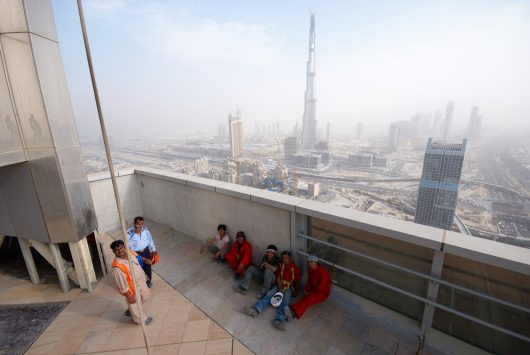
  6. Poverty in the UAE can be seen in the labor conditions of the working class. Migrants come to Dubai looking for work and send remittances back to their families. They are promised good pay and healthy living conditions; unfortunately, these assurances are rarely fulfilled.
  7. The economic crisis of 2008 confused poverty statistics. Pre-economic crisis, the poverty rate of the UAE was around 20 percent; currently, the UAE reports their poverty rate to be zero, based on a poverty line of around $22 a day.
  8. Reporters in the UAE are discouraged to write about poverty. The government controls information surrounding the state and has the power to suppress facts about reality.
  9. The economy is entirely dependent on trade and oil. Thus, government subsidies are needed when global prices fall.
  10. Economic distinctions are based on nationality and gender. Women are routinely discriminated against in hiring decisions, contributing to a gap in the poverty rates.

Room for Growth in the UAE

These facts about poverty in the United Arab Emirates show that although stable in many regards, the UAE could do with foreign aid and government assistance.

While the country has impressive employment rates and GDP per capita, the percentage of citizens living in or at poverty level is striking. Thankfully, the local government of the UAE has implemented assistance programs in an effort to reduce and relief local poverty. But also in the meantime, assistance should be offered and readily available for those in need.

– Haley Hine
Photo: Google

Global Inequity: Nigeria. Then and now in 2020. What you are never told. Look beyond your highrise. September 2020

 https://theconversation.com/lagos-size-and-slums-will-make-stopping-the-spread-of-covid-19-a-tough-task-134723

Lagos’ size and slums will make stopping the spread of COVID-19 a tough task

Author


Human vulnerability has come to the fore with the coronavirus practically bringing the world to its knees. National and city governments are taking bold steps for mitigation and containment.

In Nigeria, the federal government has announced some measures including restrictions of movement in Abuja, the federal capital and Lagos, the current epicentre of the virus. Prior to this, the Lagos state government has set in motion a series of activities including shutting down large markets, disinfection of public places, and restrictions on gatherings of more than 25 persons.

What does this mean for a city like Lagos, with over 26 million people?

Lagos poses a set of particular challenges when it comes to making these interventions work. These range from the sheer size of the city – its built up area stretches over 82,684 hectares, with a density of 209 people per hectare.

This is gargantuan when compared to bustling New York which has 25 people per hectare in its built up area of 951,103 hectares. The peri-urban space extends to the neigbouring Ogun state which is also in total lock down because of its proximity to Lagos.

Economic inequalities have consequences for access to health and health seeking behaviour. Over 60% of the residents of Lagos are poor and live in the over 100 slums and informal settlements  scattered across the city. They lack water, sanitation and other basic services. This makes them particularly vulnerable during a health crisis.

And as most residents rely on the informal economy, they are open to deprivation in the face of an economic shutdown.

The actions the government has called for are impossible to meet under these conditions.

Infrastructure deficit

Take self-isolation: how can Nigerians self-isolate in a typical slum setting where one house of ten rooms accommodates over 80 inhabitants sharing two toilets and baths?

Hand-washing: How can the inhabitants of Lagos maintain prescribed hand washing protocols when they have to buy water by the bucket? Only 44% of the state is covered by public water supply and this serves less than 16% of the population.

Access to health care: Nigeria has a fragile health system. The country has 0.8 beds per thousand population. Lagos itself has only one hospital for the treatment of infectious diseases, and is scampering to build makeshift isolation centres for the treatment of coronavirus.

There are 288 primary health centres in Lagos and these would ordinarily have been an important line of first defense and information sharing. But many of them lack the capacity to provide essential health-care services due to poor staffing, inadequate equipment, poor distribution of health workers, poor quality of health-care services, poor condition of infrastructure, and lack of essential drugs.

Livelihoods and survival: the imminent lock down of the city poses a challenge to the 68% of Lagosians who earn a living in the informal sector. How do they stock up on food and other essentials when there is no money?

Most people living in informal settlements are more concerned about survival than what’s been described as a “foreign” disease attacking the rich and the elderly – as most of the cases, so far, have been international travellers and their contacts.

Communication: So far, the major means of communicating COVID-19 related information has been via social media, particularly twitter. The result is that people living in informal settlements are cut off from accurate information flow. Where there is communication through radio and television, poor power supply means that sectors of the city are without cover for many hours.

Transport: keeping a safe distance from people is also a pipe dream given Lagos’s chaotic public transport system. Over 20 million trips are made daily on the Bus Rapid Transit system which have carrying capacity of between 40 and 85 people, and danfo (mini-buses) which are usually 14-18-seaters. This effectively puts those who patronise public transportation (67% of all commuters) at risk of infection. How feasible is it to maintain the 2 meters social distancing recommended in the danfo buses?

The Lagos state government asks bus drivers to operate at 60%. This is unrealistic given that the current system is already overstretched.

An opportunity?

Going forward, Lagos must see the crisis as an opportunity to address glaring gaps in its urban planning – especially at local levels.

For example, the links between public health and urban planning have been ignored up until now. These should be reconsidered, building on citizen led efforts.

Though informal settlements are fraught with urban challenges, they also manifest immense agency, with the poor often harnessing resources, both tangible and intangible, to mitigate the effects of obvious challenges. Community profiling programmes have resulted in street numbering and resident identification, while residents’ associations have built local clinics, installed boreholes and street lights.

Studies in 2013 and 2015 also show that in Lagos, community development efforts can be a huge contributor to better overall health outcomes.

The Bubonic plague of the 1920s opened the pathways for urban planning in Lagos. The interventions at the time resemble the current approaches – the disinfection of public places, removal of patients to the Infectious Disease hospital and a campaign for household hygiene.

The establishment of the Lagos Executive Development Board also pioneered the development of new housing estates to resettle those affected by the Oko Awo clearance.

In the same way, COVID-19 presents an opportunity for Lagos to rethink and redo urban planning and development. To start with, three practical steps can be taken.

The public health and planning interface can be strengthened. This can be done through slum upgrading and the provision of basic services such as waste management, sanitation facilities and water.

The adoption of a humane and inclusive approach to urban (re)development. Authorities need to recognise the agency of the poor by adopting bottom up participatory planning approaches in which residents contribute fully in the development of their communities.


Popular Posts

ARCHIVE List 2011 - Present

Search This Blog

Environmental Justice

Recovery\Homeless Shelters. U.S.