“The illiterate of the 21st century will not be those who cannot read and write, but those who cannot learn, unlearn, and relearn.” -Alvin Toffler

Tuesday, July 27, 2021

Homeless. A Systems Approach Solution. ....assist individuals who are homeless, at risk of homelessness, fleeing domestic violence, or were recently homeless or have a high risk of housing instability

 Federal Relief Resources for Renters and

Landlords

The Centers for Disease Control and Prevention (CDC) recently announced a one-month
extension of the CDC Eviction Moratorium expiring on July 31, 2021. USDA recognizes
the COVID-19 pandemic has triggered an almost unprecedented housing affordability
crisis in the United States. The American Rescue Plan (ARP) provided billions of dollars to support distressed tenants and landlords and USDA continues to collaborate with federal partners to ensure Rural America receives ample relief. Provided below is information on several federal resources designed to help those facing rental hardship or eviction

U.S. Department of Housing and Urban Development (HUD)

The Emergency Housing Voucher (EHV) program will provide 70,000 housing choice
vouchers to local Public Housing Agencies (PHAs) in order to assist individuals who are
homeless, at risk of homelessness, fleeing domestic violence, or were recently homeless
or have a high risk of housing instability. For more information on eligibility and how to
apply, please visit this link. HUD and USDA have also partnered on developing a Frequently Asked Questions (FAQs) fact sheet, which can be f
ound here. Information in Spanish can be found here.


Consumer Financial Protection Bureau (CFPB)

CFPB provides additional resources to inform renters of potential options to help them stay in their homes. Please visit CFPB’s Renter Protections resource webpage for more information. Information in Spanish can be found here.e found here. Information in Spanish can be found here.

U.S. Treasury
Even as the American economy continues its recovery from the devastating impact of the
pandemic, millions of Americans face deep rental debt and fear evictions and the loss of
basic housing security. To meet this need, the U.S. Treasury’s Emergency Rental
Assistance (ERA) program makes funding available to assist households that are unable
to pay rent or utilities. The funds are provided directly to grantees such as states, U.S.
territories, local governments, and (in the case of the first round of funding) Indian tribes.
Grantees use the funds to provide assistance to eligible households through existing or
newly created rental assistance programs. To learn more about how to apply for
emergency rental assistance in your state, please visit this link. Information in Spanish for renters can be found here, and information in Spanish for landlords can be found here.

Courses & Professional Development. Berkeley Food Institute. July 27, 2021


Join a New Food History Course!

View this email in your browser


Photo by: Jonathan Fong


Courses & Professional Development


Interested in taking food systems classes at Berkeley? See a comprehensive list of undergraduate and graduate food systems course offerings here


Wiki Focus: Black Women in Food History
Because Of Her Story
July 27

See event details and registration here


Virtual Open House
Food Safety and Inspection U.S. Department of Agriculture
August 2

See event details and registration here


2021 Fall Nutrition Course 
NUSCTX 20 Personal Food Security and Wellness
Join Today

See course details here.


2021 Fall Food History Course
HISTORY 103D Foodways: An Edible History of Modern Capitalism
Join Today

See course details here.


Monday, July 26, 2021

Upcoming Flood Insurance Webinars for Agents Presented by the National Flood Insurance Program August 2021 - Register Now!


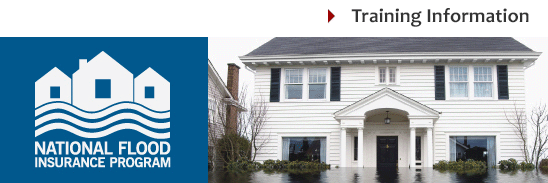
NFIP Header

Upcoming Flood Insurance Webinars for Agents

Presented by the National Flood Insurance Program

August 2021 - Register Now!
(Capacity is Limited)


Key Fundamentals of Flood Insurance for Agents
Parts One and Two

Please register for both parts of this webinar.

Part One: August 4 - 2:00 p.m. - 4:00 p.m. Central Time - REGISTER
Part Two: August 5 - 2:00 p.m. - 4:00 p.m. Central Time - REGISTER

Insurance agent continuing education course approval and credits vary by state. CLICK HERE for information about your state. 

Can't attend these sessions? Watch for more opportunities soon.


TWO-PART KEY FUNDAMENTALS WEBINAR

This webinar is a two-part course on FEMA's National Flood Insurance Program. It includes the topics listed in the Federal Register notice on training and education requirements related to Section 207 of the Flood Insurance Reform Act of 2004, otherwise known as FIRA 2004.

It brings participants the latest information on reform legislation impacting the NFIP and reviews the key elements insurance agents need to know about the NFIP and how it works. It also discusses many of the federal flood program’s general rules as well as some more advanced topics. For more information visit our Key Fundamentals of Flood Insurance overview.

Attendees must complete both sessions in order to cover all topics required by the Flood Insurance Reform Act (FIRA) of 2004.

REGISTRATION INFORMATION

To register, please use the links above. These webinars are FREE to attend, but spaces are limited so please register early.

Can't attend these sessions? NFIP Training conducts webinars on flood insurance topics regularly. Watch for more upcoming opportunities. If you are not a subscriber to NFIP agent training bulletins, please sign up here.

CONTINUING EDUCATION CREDITS

Continuing education course approval and credits vary by state for insurance agents. Click Here for information about your state. Some states (e.g. California, Illinois, Michigan, Oklahoma, Utah and Virginia) require that both parts of the course be successfully completed in the same offering to receive any credit hours.

Both parts of the course must be completed to meet the FIRA 2004 training requirement. Periodic learning checks will be conducted to measure attendee engagement. Learning checks must be completed by each registered attendee to earn continuing education credit. Only registered attendees are eligible to receive continuing education credits. No exam is required.

Currently, there are no continuing education credits available in Puerto Rico, Guam or the Virgin Islands.


State Mandatory Notifications 
(Language is written as provided by the state)

Colorado - This two-part course is approved by the Colorado Division of Insurance for Continuing Insurance Education Credit.

Connecticut - Approved by the State of Connecticut Insurance Department for insurance producer continuing education credit.

Florida - Each part of this course has been approved by the Florida Department of Financial Services for insurance continuing education credit.  FL Provider: H2O Partners, Inc. (#365883); Course: Key Fundamentals of Flood Insurance for Agents - Part 1 (Webinar) (#106200); Course: Key Fundamentals of Flood Insurance for Agents - Part 2 (Webinar) (#106202).

New Mexico - This course has been approved by the Insurance Continuing Education Committee as a New Mexico Insurance Continuing Education Course.

South Carolina - This course is approved by the South Carolina Department of Insurance for Continuing Insurance Education Credit.


Please do not reply to this email. If you have any questions, please email floodsmart@fema.dhs.gov .


Sign Up for NFIP Agent Training Bulletins


FEMA 

The National Flood Insurance Program is administered by the Federal Emergency Management Agency (FEMA), a component of the U.S. Department of Homeland Security

NFIP

National Flood Insurance Program Training

Popular Posts

ARCHIVE List 2011 - Present

Search This Blog

Environmental Justice

Recovery\Homeless Shelters. U.S.