Every year, thousands of men, women,
and children fall into the hands of traffickers, in their own countries
and abroad. Almost every country in the world is affected by
trafficking, whether as a country of origin, transit, or destination
for victims. In a new
study released this month by the UN Office on Drugs and
Crime (UNODC), the pandemic was shown to have “increased
vulnerabilities to trafficking in persons while making trafficking even
harder to detect and leaving victims struggling to obtain help and
access to justice,” said UNODC Executive Director, Ghada Waly.
Tomorrow, the United Nations observes 30 July as World Day Against
Trafficking in Persons. We encourage you to take action by learning
more about this grave violation of human rights. We created this free
online training in partnership with The Salvation Army. It provides
guidance on identifying the signs of trafficking and supporting
survivors.
By learning how to recognize and take appropriate actions to respond,
we can help put an end to human trafficking.
MAYOR CANTRELL
ANNOUNCES RETURN OF BLUE BIKES BIKE SHARE PROGRAM TO NEW ORLEANS
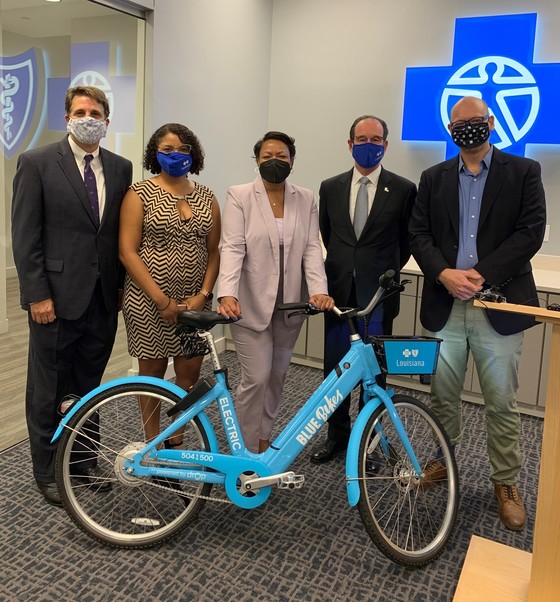
NEW ORLEANS — Mayor LaToya Cantrell today announced
that Blue Bikes, Louisiana’s first bike share program, will return to
the City of New Orleans later this summer. A fleet of 500 pedal-assist
e-bikes will be ready to ride by Sept. 1.
“The
upcoming launch of Blue Bikes is a major accomplishment in our
commitment to improve equity, connectivity, safety and efficiency in
our transportation networks. Bike share is a critical component of our
transportation system; people rely on it to get to work, and we are
excited that 500 bikes will be back on the streets soon. We appreciate
the partnership in the Greater New Orleans Foundation, which helped
develop the new program, and are thankful for the return of Blue Cross
Blue Shield of Louisiana as lead sponsor. Blue Bikes is returning
better than before, with a greater focus on supporting our community
every step of the way,” said Mayor
Cantrell.
The city
announced the relaunch of Blue Bikes in partnership with Blue Krewe, a
local, community-based nonprofit organization that operates the
program, and title sponsor Blue Cross and Blue Shield of Louisiana.
Mayor
Cantrell was also joined by Office of Transportation Director Laura
Bryan and Policy and Program Manager Dan Jatres; President and CEO of
Blue Cross Blue Shield Dr. I. Steven Udvarhelyi; Board Member of Blue
Krewe Destinie Hammond; President & CEO of Greater New Orleans
Foundation Andy Kopplin; and Executive Director of Bike Easy Dan
Favre.
About
Blue Bikes 2.0
Blue Bikes
first launched in 2017 and was in operation through spring 2020. During
that time, residents and visitors embraced Blue Bikes as a valuable
community asset. Bike share offered a healthy, environmentally-friendly
and accessible transportation option to move around the Crescent City.
When Blue
Bikes relaunches, the initial system area will include parts of the
Lower Garden District, Central City, the Central Business District, the
French Quarter, the Marigny, the Bywater, the 7th Ward, Tremé, Mid-City
and the lower section of City Park.
Blue Bikes
2.0 will have a particular focus on serving areas identified in the
City of New Orleans’ Bicycle Equity Index, which are primarily
lower-income and communities of color with low car ownership rates. The
program will connect these neighborhoods to job centers and amenities.
Additionally,
through dedicated outreach with specific metrics to measure progress,
Blue Bikes 2.0 will ensure that bike share is easily accessible for
residents of color and low-wealth communities, residents who work in
the service and hospitality industry, and/or residents who lack access
to other transportation options.
People can
sign up to ride Blue Bikes by downloading the Blue Bikes Nola app.
People can also ride through the $0.15 per minute Pay As You Go option
or with a $25 monthly membership. Additionally, through the Blue Bikes
for All program, New Orleans residents who qualify for Medicaid or
Louisiana Purchase (SNAP) will be able to access a reduced-price plan
of $4 per month. To learn more about the Blue Bikes pricing and system
area, visit BlueBikesNola.com.
"We
are proud of our partnership with Blue Krewe and the City of New
Orleans to bring this healthy, environmentally friendly, affordable
transportation option back to the Crescent City," said Dr. I. Steven Udvarhelyi, Blue
Cross and Blue Shield of Louisiana President and CEO.
"Blue Bikes promotes healthy exercise and gives residents an easy
way to get to work or school, go to medical appointments or shop at
full-service grocery stores and farmers markets. We know from the first
round of the program that Blue Bikes meets transportation needs in the
New Orleans community, and we’re looking forward to seeing the bikes
rolling through city streets again."
Blue
Bikes 2.0 Operations
During its
first years of operation, the Blue Bikes program was highly successful,
with riders logging more than a million miles within the first two
years and eliminating more than a million miles in carbon offset — a
gasoline cost savings of nearly $700,000. Trips taken and miles ridden
jumped up each year of Blue Bikes’ operation, as more people embraced
the program.
The
original Blue Bikes system shut down in spring 2020 following ownership
changes that led to the previous out-of-state corporate operator ending
bike share operations in the New Orleans market.
But,
recognizing the importance of Blue Bikes for New Orleans and the need
for local control of the city’s bike-share system, local bike share
enthusiasts – including former Blue Bikes staff, bicycling and walking
advocates, philanthropists and community healthcare organizations – came
together to form Blue Krewe last year. The Greater New Orleans
Foundation provided critical start-up funding and fiscal sponsorship
for Blue Krewe. Blue Krewe's partners include Bike Easy, title sponsor
Blue Cross and Blue Shield of Louisiana, and the City of New Orleans.
“When
corporate decision-makers far from New Orleans shut down our bike share
program during the middle of the pandemic, we knew we needed the next
era of bike share to be controlled locally,” said Andy Kopplin, President &
CEO of the Greater New Orleans Foundation and Treasurer of the Blue
Krewe board. “The Greater New Orleans Foundation was
thrilled to work with Mayor Cantrell and our partners to create the new
nonprofit structure and provide critical seed capital and fiscal sponsorship
to get Blue Krewe off the ground.”
Blue
Krewe’s governance structure as a community-based nonprofit
organization is specifically designed to ensure the long-term
sustainability of an equitable bike share program in New Orleans.
Blue Krewe
has assembled a board of directors with a wealth of experience and
dedication to Southeastern Louisiana. Blue Krewe’s Board of Directors
includes:
Board
President Corey
Hebert, CEO, College Health TV and Chief Medical
Editor of Black News Channel
Board
Secretary Dan
Favre, Executive Director of Bike Easy
Treasurer
Andy Kopplin,
CEO and President of the Greater New Orleans Foundation
Board
Member Destinie
Hammond, Communications Manager for the North
American Bikeshare Association
Board
Member Emilie
Bahr, Urban Planner and Walking + Biking
Evangelist
Ex-Officio
Board Member Laura
Bryan, Director of the City of New Orleans Mayor’s
Office of Transportation
Ex-Officio
Board Member Rod
Teamer, Director of Diversity Program and Business
Development, Blue Cross and Blue Shield of Louisiana
For more
information and timely updates on the Blue Bikes 2.0 launch, visit BlueBikesNOLA.com
or follow Blue Bikes on Facebook, Twitter and Instagram @BlueBikesNOLA.
# # #
About Blue Krewe
Founded in
New Orleans in 2020, Blue Krewe is a local, community-based nonprofit
that manages and operates the Blue Bikes program. Recognizing the
importance of Blue Bikes as a healthy, equitable, and
environmentally-friendly transportation option, local bikeshare
enthusiasts – such former Blue Bikes staff, biking and pedestrian
advocates, philanthropists and community healthcare advocates – came
together to form Blue Krewe. Here at Blue Krewe, we are committed to
our mission to provide the Greater New Orleans region with equitable
shared micro-mobility solutions that are rooted in and supportive of
our community.
City of New
Orleans Mosquito, Termite and Rodent Control Board to Conduct Adult
Mosquito Abatement Tonight
NEW ORLEANS — The City of New Orleans Mosquito, Termite,
and Rodent Control Board (NOMTRCB) will conduct adult mosquito
abatement tonight.
Treatment will be conducted by airplane in the area
bordered by Bayou St, John, Paris Road, Lakeshore Drive and I-610.
Truck applications will also take place in New Orleans East in the area
bounded by I-10, Dwyer Road, Chef Menteur Highway and Bullard Avenue. Treatments
will take place from 8:15 p.m. to 12:15 a.m., weather permitting.
Frequent
or heavy rainfall can significantly increase mosquito populations by
creating breeding habitat. Mosquitoes lay eggs in anything that holds
water and can develop from eggs to adults in less than a week. Some
examples of common breeding habitats are tires, buckets, wheelbarrows,
clogged gutters, unkept swimming pools, tarps or other plastic
sheeting, grill covers, kiddie pools, water tables, drink cups or
aluminum cans, pet water dishes, and trash cans or lids.
West Nile
and other mosquito-borne viruses are more active in the summer and
early fall. Currently, no human cases have been reported in Orleans
Parish; however, we are asking residents to remain vigilant and to turn
over or remove any items that hold water to prevent mosquito breeding.
Residents should expect elevated mosquito activity in the next days and
weeks with frequent summer storms and rainfall. Any time after a rain
is a good time to look around residential property for containers that
might be holding water.
NOMTRCB
will perform city-wide control activities to manage mosquito
populations as frequently as weather permits. Please call 311 or visit https://nola311.org/
to report mosquito issues such as tire piles, abandoned pools or areas
with standing water that do not drain properly.
Reduce
mosquito exposure by limiting outdoor activities between dusk and
dawn.
Use
air-conditioning and make sure window and door screens are in good
repair to prevent mosquitoes from getting inside.
Wear
long-sleeved shirts and pants while outside.
The
CDC recommends using repellents containing EPA-registered active
ingredients including DEET, picaridin, IR3535, or oil of lemon
eucalyptus.
When
using insect repellent, always follow the recommendations on the
product label.
Protect
Your Home
Eliminate
standing water where mosquitoes breed.
Remove
trash and clutter, dispose of discarded tires and containers that
can hold water. Turn over wading pools, buckets, trash cans,
children's toys, or anything that can collect water.
Change
water weekly in containers that cannot be removed such as pet
dishes or bird baths. Scrub the side of the containers with a
sponge or brush each week to remove mosquito eggs.
Rain
barrels and other water collection devices must be
screened, and collected water should be used within one week.
Aerate
ornamental pools, fountains and sugar kettles or stock them with
mosquitofish.
Report
illegal dumping, water leaks and unattended swimming pools by
calling 311.
Call
311 to report other mosquito problems.
Report
Tires
Tires
are easily filled with rainwater and collect leaves and litter,
providing ideal breeding conditions for mosquito larvae. Removal
of scrap tires will eliminate a prolific mosquito habitat.
Residents
can call 311 to request a bulk waste pickup of up to four
tires. Tires should be stacked curbside next to City-issued trash
containers.
Tires
in front of abandoned lots, unoccupied properties, or businesses
are ineligible for pick up and will not be collected. This issue
is currently being addressed through City-coordinated, cooperative
efforts towards treatment and removal.
Follow
NOMTRCB on Facebook, Instagram and Twitter @nolamosquito.