http://www.finalcall.com/artman/publish/National_News_2/Toxic_Terror_in_San_Francisco_4345.shtml
Toxic Terror in San Francisco
BY CHARLENE MUHAMMAD
STAFF WRITER | LAST UPDATED: JAN 29, 2008 - 11:12:00 AMCoalition fights community exposure to asbestos, other hazards
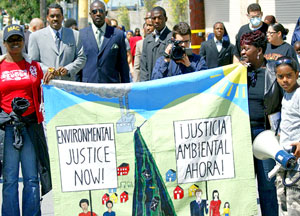
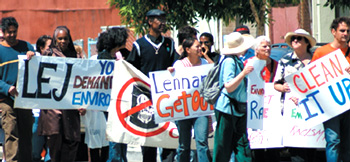 Protestors demand clean up of toxic site in Bay View Hunters Point. Photos: Charlene Muhammad |
SAN FRANCISCO (FinalCall.com) - A cross section of Black, Latino, Asian-Pacific Islander and progressive Whites are determined to win a battle with city and congressional leaders over what activists call one of the most horrific cases of environmental racism and political double dealing in the country.The fight began when children at the Muhammad University of Islam (MUI), which sits at the top of Bay View Hunters Point, were unknowingly exposed for months, maybe longer, to asbestos and other cancer-causing toxins when the Lennar Corporation a multi-billion dollar housing developer began grading a hill directly beside the school to make way for 1,500 homes on the site of the old Hunters Point Naval Shipyard.
MUI opened its doors to the community in 1997 and moved to its current location in Hunters Point in 2002. It currently educates Muslim children as well as children from across the city. Currently the school educates about 100 students and often, as they played outside during recess and physical education classes, thick, toxic dust would begin to blow in a tornado-like pattern over the schoolyard.
During that same period, Leon Muhammad, MUI’s dean, noticed that the children began complaining about breathing problems, and experiencing chronic nosebleeds, skin rashes, asthma and eye swelling. One student became so ill she was hospitalized for a month for bronchitis.
Catherine Muhammad’s son developed skin rashes, but his worst experience was being sent home from school after his actual eyeball swelled up. Her two-year-old daughter underwent surgery and a three-day hospital stay to remove hardened mucous from her left lung.
Eleven-year-old Amos Loto attends the school, which sits right across the street from his family’s housing unit.His nose has bled since he was four-years-old.His 30-year-old aunt, Puni Paopao, who rears him, told The Final Call that when she moved here in 1996 to take care of her mother, she was perfectly healthy, but in 2003, she was diagnosed with uterine cancer.
“I was a healthy person and worked two jobs when I lived in Monterey, but now I’m permanently disabled.I have to take seven pills and sleep with a breathing machine, but the doctors say they don’t know why.I really want something to be done because our people are getting sick and we don’t know why.We have to find out for the children,” Ms. Paopao said.
Chris Carpenter, who had worked to clean up the toxic site under a sub-contractor hired by Lennar, alerted Student Minister Christopher Muhammad of Muhammad Mosque No. 26 and MUI of the potential health hazards to the children, whom he noticed remained playing outside after dust conditions caused work crew shutdowns.
“I wanted to do the right thing as far as expose the company of their wrongdoings.What I’ve learned from this is that no one cares about our community.They were exposing us to asbestos without any warning, and they didn’t care,” Mr. Carpenter told The Final Call.
As Mr. Muhammad began investigating, he found that the health threat, kept a secret by the developer, also reached into the community, and he, the Muslims and a handful of environmental activists, including Francisco Da Costa, president of the Environmental Justice Advocacy, and Alicia Schwartz of People Organized To Win Employment Rights (P.O.WE.R.), began its campaign to stop Lennar. Mr. Muhammad led the believers of Mosque No. 26 on a door-to-door campaign, with the community telling residents about potential dangers and they united in efforts to protect residents of the predominantly Black community. In weekly town hall meetings, which have been going on for nearly a year, the coalition plots strategy, hears resident concerns and gives out information. The Jan. 17 town hall meeting at Grace Tabernacle Church under the leadership of Bishop Ernest Jackson was packed.
“You know what, why does Minister Muhammad still have his kids up there?” Mayor Gavin Newsom asked, according to the San Francisco Sentinel. “He was given an opportunity to move his kids,” he added.
But Mr. Muhammad said that all children of Bay View Hunters Point have the right to breathe clean air. “This is not just about the children who attend the MUI. If we pulled our school of the area, who would advocate for our people and warn them about what they’ve been exposed to and organize to fight for them? What Mayor Newsom, Lennar and its surrogates wanted me to do was leave the community exposed, and they hoped that this whole issue of their poisoning our babies and community would go with me,” Mr. Muhammad stated.
“This movement that’s happening in this community will give birth to a nationwide movement. If you look at us as the embryo, we’re growing up quickly and all of us have had to make some very difficult decisions.People who we thought were friends have turned their backs on us, but we have knitted our souls together,” said Bishop Jackson.
Archbishop Franzo King of the African Orthodox Church Jurisdiction of the West credited Mr. Muhammad with sustaining the movement for environmental justice. “He is an articulate speaker, who has taken this thing to heart and conducted himself as an A+ student on this issue. That has a lot to do with the confidence that the people have in this man has made this his personal education experience. It also has sustained because Min. Louis Farrakhan has raised him and sent him to this city in a time when it needs a voice that can speak without cracking, without reservation and with his eyes set on pleasing God instead of Pharaoh.”
“They’re our brothers and sisters who are being contaminated because of what our government is doing and if I care about the people of Iraq and want them to stop dying for no reason of course I want my neighbors to stop being contaminated and dying and getting all these diseases,” said Cindy Sheehan, a congressional candidate and former peace activist.
Members of the African American Community Revitalization Consortium, comprised of local churches, merchants, residents and organizations, opposed the community’s quest for justice. “Yet, this group is backed by Lennar and draws its members from among those with a personal financial stake in the company’s San Francisco projects,” wrote San Francisco Bay Guardian reporter Sarah Phelan. In addition there were efforts to discredit Mr. Muhammad and the coalition in the community.
Despite the staunch opposition, also leveled by other Black political leaders whom critics allege struck personal backroom deals involving housing and money, the coalition has remained strong, focused and intact for the last year and a half. The coalition kept fighting and built a strong committed movement against an economically and politically powerful corporation and city political power structure.
No warning from developer
Lennar, the Florida-based conglomerate, is the number one home builder in America. It boasts a portfolio of about $1.3 billion, yet was able to purchase one of four parcels of the Naval Shipyard from the city for $1 and with the aid of Mayor Newsom, Sen. Dianne Feinstein and Speaker Nancy Pelosi, who received $82 million from the defense budget to help with the clean up. In a rush to build a football stadium to keep the San Francisco 49ers, who are looking to leave the city when their contract expires in several years, as well housing, parks, roads and other improvements, the city is overlooking critical health impacts to Hunters Point residents, advocates say.Part of Lennar’s promise was to perform certified Asbestos Surveys; place two monitors on the site to conduct real-time air monitoring upwind and down; and reduce dust by watering all exposed asbestos containing materials.
According to Mr. Muhammad, when he asked questions about whether the construction was exposing children to danger, Kofi Bonner, president of Lennar’s Bay Area Urban Land Division, said there was nothing to worry about. Mr. Bonner said exposure levels were so low the children’s health had not been negatively impacted and it would take 70 years of exposure before any cancer or respiratory problems would occur, Mr. Muhammad said.
“The Lennar corporation did not come to us and tell us our children and community were in danger.We learned this from a whistleblower on their site.They were working 10 feet from children who were already suffering the historic impacts of environmental injustice. When you know you’re operating in a community like this, you have to be extra careful but they didn’t do that.This is murder with intent,” charged Mr. Muhammad.
He asked Lennar to temporarily stop working until the health of the children could be assessed, but the company refused.
The San Francisco Department of Public Health also denied Mr. Muhammad’s repeated requests to have the children tested for exposures to toxins coming from the shipyard with epidemiologists and toxicologists. Dr. Mitchell Katz, San Francisco Director of Health, has the power to order work stoppages if he discovers potential health risks, but in a December 1, 2006 letter, he wrote that shipyard operations presented no potential health risk to the community, although no child had been tested.
Last year, the Center for Self Improvement, a non-profit created by Mosque No. 26, filed a lawsuit on behalf of the community against Lennar and its contractor, Gordon Ball, under Proposition 65 (California’s “right to know” law), alleging that the companies had graded and excavated asbestos-laced materials without informing the school or the community. The Center said it was not until October 2006, several months after intensive grading began, that it learned that Lennar’s construction was creating asbestos dust.
Meanwhile, three highly-placed Black employees of Lennar filed a lawsuit, after they were silenced and demoted for allegedly voicing concerns about health and safety violations at the school and in the community. “This lawsuit by these courageous African Americans confirmed the community’s worst fears about exposures to these deadly toxins,” Mr. Muhammad said. The community is contemplating a class-action lawsuit against Lennar for health and safety violations as well.
Shipyard’s hazardous history
The Hunter’s Point naval shipyard is one of America’s 10 most toxic sites and is currently on the Environmental Protection Agency’s Superfund site list, which means it is prioritized for cleanup because of radioactive contamination. The naval shipyard already posed a threat to the health of residents because it is contaminated with radioactive wastes and other hazardous agents.It was once used by the Navy for radiological testing on humans and animals, and to decontaminate and dispose of ships returning from nuclear weapons tests in the North Pacific Ocean. This shipyard was also the location where the Atomic bombs were assembled that were dropped on Hiroshima and Nagasaki Japan in World War II.
“They filled a back bay with radioactive trash and animals, covered it, and called it a radioactive landfill … and they also filled up a battle ship at Hunters Point with radioactive waste from nuclear weapons developments, and sunk the ship, as well as 55 gallon drums of radioactive wastes into the ocean off of the San Francisco coast,” said Leuren Moret, a California-based scientist and expert on depleted uranium.
That’s why the mostly Black residents of Hunters Point already have the highest rates of cervical and breast cancer, prostate cancer, diabetes and other illnesses in the country, Ms. Moret told The Final Call.
Public health officials still have not tested any families to date. Dr. Abdul Alim Muhammad, Nation of Islam minister of health, conducted preliminary testing of MUI students and some community residents, and detected arsenic and other contaminants.
The city public health agency says it won’t conduct any tests. It claims that there is no available method to accurately test exposure to asbestos, however there are tests for other inorganic substances such as lead, arsenic, and magnesium. The city responded to community complaints by conducting a hypothetical air-monitoring test to determine what exposure levels might have been, without direct testing of residents.
The community has been unable to determine the affects of exposure to the asbestos dust because Lennar failed to properly monitor dust levels as required. It presented its Dust Mitigation Plan to residents on July 11, 2005 and on July 14, 2005 Lennar began working at the shipyard in violation of their agreement with the Bay Area Quality Management District which cited Lennar for failure to follow health and safety standards.
“This proves that Lennar knew what they were doing and intended not to follow policies.They started the job disregarding what they promised the community from day one, they were issued a notice of violation, but were not fined or stopped further placing our community at risk,” said Mr. Muhammad.
In a January 9, 2007, letter from Dr. Rajiv Bhatia, the health department’s director of environmental health, to Dr. Muhammad stated there is no doubt that children were exposed to “naturally occurring asbestos and other inorganics” —though there was no viable way to test them.
When Lennar finally installed community air monitors according to the State of California Department of Public health they were using the wrong monitors. The monitors were installed improperly and the data collected was useless, according to heath officials.
“They don’t want to test the children or the community and the main reason is liability issues, and the other is to avoid delaying clean-up of the site, because the City wants to keep the 49ers football team here, and this is where Lennar and the city of San Francisco started to hunker down and cover their tracks,” Mr. Muhammad charged.
Political leaders accused of failure
Mayor Gavin Newsom, Senator Dianne Feinstein, House Speaker Nancy Pelosi have connections to the Lennar Shipyard project. It is alleged in some news accounts that Sen. Feinstein’s husband owns Blum Capital Investments, which has interests in the project.Speaker Pelosi’s nephew was the director of the naval base acquisitions for Lennar, and he is Mayor Newsom’s cousin.All three want the 49ers to remain in San Francisco.
“The money will flow, the dirt will fly, progress will get made,” Speaker Pelosi declared.
The progress she touted comes at the neglect of community’s health issues, the coalition insists.
The community coalition says officials have had years to clean up the site, but only moved into action after the NFL’s San Francisco 49ers professional football team announced plans to move to Santa Clara, when its contract ends in 2012.
Mayor Newsom said the three politicians have been working for years to transform the blighted shipyard into something useful. Sen. Feinstein concurred. Speaker Pelosi claimed her efforts centered on improving the health and economic well-being of Hunters Point—not retaining the 49ers.
The community coalition said if that were true, she would use her clout as the Speaker of the House to force testing of residents to determine the level of toxic dust contamination.
Asbestos is a group of minerals that occur as bundles of thin, invisible fibers, which produce a hardening agent.Asbestos fibers are released from serpentinite rock when it is crushed or broken, and through natural weathering processes. According to the National Cancer Institute, and the California Environmental Protection Agency, there are no safe levels of asbestos exposure and all forms of asbestos fibers can cause cancer.
The right to a safe environment
The city Board of Supervisors declares in its San Francisco Precautionary Principles, that every San Franciscan has an equal right to a healthy and safe environment. The policy also says the city has a duty to take anticipatory action to prevent harm, where there are grounds for reasonable concerns. The community also has a right to complete and accurate information on potential human health and environmental impacts; and decisions applying the principles must be transparent, participatory and informed. Lastly the city must act quickly at the appearance of harm and not wait for scientific confirmation before moving to protect residents.
Norris McDonald, of the African American Environmentalists Association, said the coalition is facing an uphill battle but it can win.His organization works for environmental justice on behalf of Blacks and others.
“We don’t have a law to protect Blacks from polluted facilities, and it’s so hard to get a law because of racism and capitalism,” he said.
Mr. McDonald said his group drafted the Environmental Justice Act of 2005, which would require federal agencies to develop and implement policies and practices that promote environmental justice.There are not many national examples of successful battles against environmental injustice, he said. His organization helped stop plant development in “Cancer Alley,” a predominantly Black, heavily industrial area in Louisiana, where people were contaminated by a power plant.
The residents of Bay View Hunters Point are still fighting for their neighborhood and launched their own initiative to force Lennar to provide affordable housing and other improvements it promised. They are working to obtain the 8,500 petition signatures that are required by Feb. 5 to have the initiative put before voters this June.